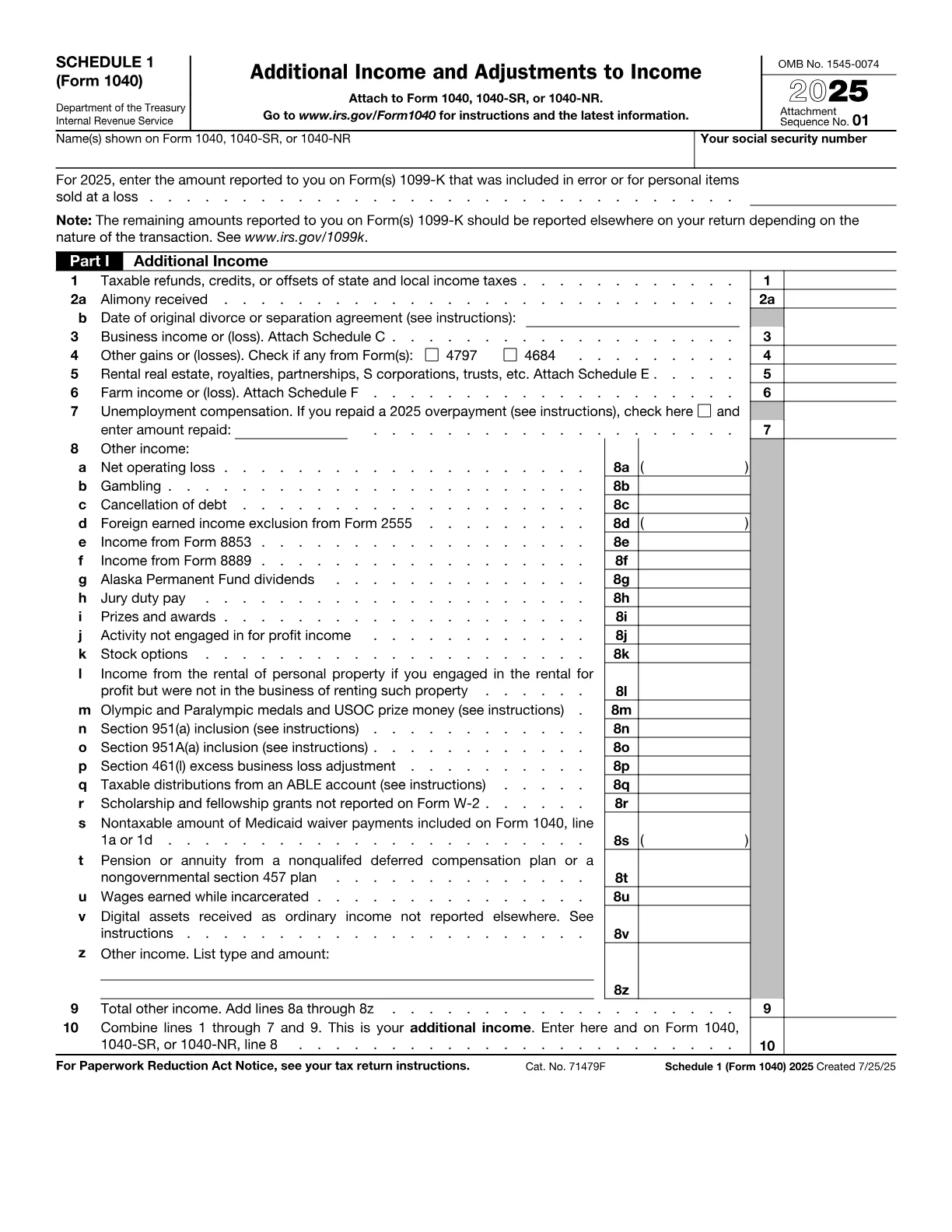
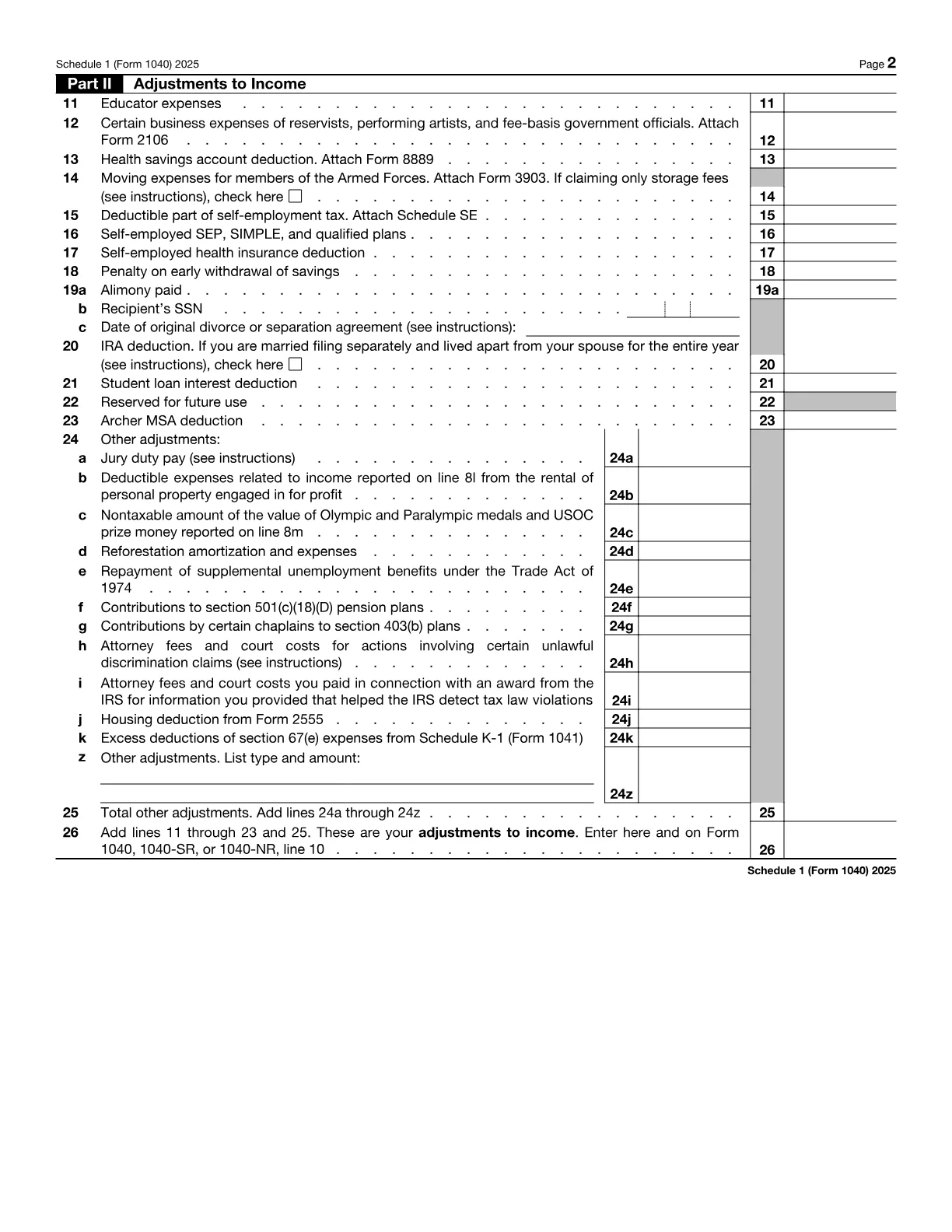
Schedule 1 reports the income and adjustments that can't be entered directly on Form 1040. Part I adds up additional income, such as business profit, rental income, unemployment and gambling winnings, and carries it to Form 1040 line 8. Part II adds up adjustments to income, such as half of self-employment tax, HSA and IRA deductions and student loan interest, and carries them to line 10.
Every line, explained
No line matches that. Try a line number like 15, or a word like alimony.
Form 1099-K amounts reported in error
1099-KForm 1099-K amounts included in error or for personal items sold at a loss
The entry space at the top of the schedule takes any Form 1099-K amount that is not income: payments included in error (gifts, reimbursements) and personal items sold for less than they cost. A personal item sold at a gain is not entered here; it goes on Form 8949 and Schedule D. The rest of the 1099-K is reported wherever the transaction belongs. For 2025 a platform has to send a 1099-K only above $20,000 and 200 transactions.
Where it comes from: Form 1099-K box 1a, and the taxpayer's records of what each payment was.
Practice returns: none use this line yet. Request one.
Part I: Additional income
1Taxable refunds, credits, or offsets of state and local income taxes
A state or local income tax refund is taxable only to the extent the tax gave a benefit when it was deducted. If the taxpayer took the standard deduction last year, or deducted sales tax instead of income tax, none of it is taxable. Otherwise the State and Local Income Tax Refund Worksheet in the instructions (or Pub. 525 for the listed exceptions) finds the taxable part.
Where it comes from: Form 1099-G and the prior year return's Schedule A.
Practice returns: none use this line yet. Request one.
2a, 2bAlimony received, and date of the divorce or separation agreement
Alimony is income only under an agreement made on or before December 31, 2018 (and not later changed to say it is excluded). Payments under a later agreement are not reported at all. Line 2b takes the month and year of the original agreement.
Where it comes from: The divorce or separation agreement and the payer's records.
Practice returns: none use this line yet. Request one.
3Business income or (loss)
Net profit or loss from each sole proprietorship, carried from Schedule C line 31. The same profit also feeds Schedule SE for self-employment tax.
Where it comes from: Schedule C.
Practice returns that fill in this line (16):
- Business meals: 50%, 100%, or nothing on Schedule C
- Colorado: starting from federal taxable income with a Schedule C
- Consultant with a SEP-IRA
- Content creator with several income streams
- Freelance designer with a home office
- Independent contractor who expected a refund
- Iowa self-employed photographer: flat 3.8% tax and the school district surtax
- Mississippi self-employed painter: Schedule C, commuting miles, SE tax, QBI, and a state that builds its own AGI
- Montana fishing guide: federal taxable income without QBI
- Online seller with inventory
- Oregon: the federal tax subtraction and the 2025 kicker for a freelancer
- Real estate agent (Schedule C, actual vehicle expenses)
- Rideshare and delivery driver (gig work)
- Six K-1s, a partnership exit, and Section 1231
- Statutory employee: W-2 wages on Schedule C
- Virginia self-employed: Schedule C, estimates, and the $4,000 Virginia529 deduction
4Other gains or (losses)New for 2025
Gains and losses from selling business property, from Form 4797 line 18b. If Form 4797 is not otherwise needed, a casualty or theft amount from Form 4684 line 31 goes here instead. New for 2025, a checkbox says which form the amount came from.
Where it comes from: Form 4797 or Form 4684.
Practice returns that fill in this line (1):
5Rental real estate, royalties, partnerships, S corporations, trusts, etc.
The net from Schedule E: rentals and royalties, plus income or loss passed through on Schedule K-1 from partnerships, S corporations, estates and trusts.
Where it comes from: Schedule E, built from rental records and Schedules K-1.
Practice returns that fill in this line (6):
6Farm income or (loss)
Net farm profit or loss from Schedule F.
Where it comes from: Schedule F.
Practice returns that fill in this line (1):
7Unemployment compensationNew for 2025
Unemployment benefits are taxable. If the taxpayer repaid an overpayment in 2025, report the net and, new for 2025, check the box and enter the amount repaid. Contributions to a governmental unemployment program reduce the amount for a taxpayer who does not itemize.
Where it comes from: Form 1099-G box 1.
Practice returns that fill in this line (1):
Part I: Other income (lines 8a to 8z)
8aNet operating loss
An NOL deduction carried in from an earlier year, entered as a negative number in the parentheses, so it reduces the other income on lines 8b to 8z.
Where it comes from: The NOL carryover from prior returns.
Practice returns: none use this line yet. Request one.
8bGambling
Gambling winnings not from a trade or business: lotteries, raffles, casino and sports betting. Losses are not netted here; they are an itemized deduction on Schedule A. Attach Form W-2G if tax was withheld.
Where it comes from: Forms W-2G and the taxpayer's gambling records.
Practice returns that fill in this line (1):
8cCancellation of debt
Debt a lender forgave is generally income, but part or all of it may be nontaxable (Pub. 4681 explains when).
Where it comes from: Form 1099-C box 2.
Practice returns that fill in this line (1):
8dForeign earned income exclusion from Form 2555
The foreign earned income and housing exclusion, entered as a negative number. The wages stay on Form 1040 line 1a; this line takes them back out.
Where it comes from: Form 2555 line 45.
Practice returns: none use this line yet. Request one.
8e, 8fIncome from Form 8853 and Form 8889
Taxable distributions from an Archer MSA or Medicare Advantage MSA (8e) and from a health savings account (8f), usually money not spent on medical care. An additional tax may also apply.
Where it comes from: Form 8853 lines 8, 12 and 26; Form 8889 lines 16 and 20.
Practice returns that fill in this line (1):
8g, 8hAlaska Permanent Fund dividends and jury duty pay
The Alaska dividend is taxable to the resident who receives it. Jury duty pay is income; if the taxpayer had to give it to an employer who kept paying salary, the same amount comes back off on line 24a.
Where it comes from: The state's payment record and the court's jury pay statement.
Practice returns: none use this line yet. Request one.
8iPrizes and awards
Prizes and awards. Olympic and Paralympic medals and USOC prize money go on line 8m instead.
Where it comes from: Form 1099-MISC box 3.
Practice returns: none use this line yet. Request one.
8jActivity not engaged in for profit income
Income from a hobby or other activity not run to make a profit. It is taxable, but it is not self-employment income, so it does not go on Schedule C.
Where it comes from: The taxpayer's records. See Pub. 525.
Practice returns that fill in this line (1):
8kStock options
Income from exercising stock options that is not already in wages on Form 1040 line 1h.
Where it comes from: The employer's exercise statement.
Practice returns: none use this line yet. Request one.
8lIncome from the rental of personal property
Rent from personal property (equipment, a vehicle, a boat) rented for profit by someone not in the business of renting it. The related expenses come off on line 24b.
Where it comes from: The taxpayer's rental records.
Practice returns: none use this line yet. Request one.
8mOlympic and Paralympic medals and USOC prize money
The value of medals and USOC prize money. If AGI is not more than $1,000,000 ($500,000 married filing separately), the amount is nontaxable: report it here and take it back out on line 24c.
Where it comes from: Form 1099-MISC box 3.
Practice returns: none use this line yet. Request one.
8n, 8oSection 951(a) and section 951A(a) inclusions
Income a US shareholder of a controlled foreign corporation must include: subpart F and section 956 amounts (8n, from Form 5471 Schedule I) and GILTI (8o, from Form 8992 Part II line 5). A shareholder who made a section 962 election reports the tax differently, not here.
Where it comes from: Forms 5471 and 8992.
Practice returns: none use this line yet. Request one.
8pSection 461(l) excess business loss adjustment
Business losses above the yearly limit are not allowed this year. The excess, figured on Form 461, is added back to income here.
Where it comes from: Form 461 line 16.
Practice returns: none use this line yet. Request one.
8qTaxable distributions from an ABLE account
An ABLE account distribution can be taxable if it was more than the beneficiary's qualified disability expenses and was not rolled over. An additional tax may also apply, through Form 5329.
Where it comes from: The ABLE account statement. See Pub. 907.
Practice returns: none use this line yet. Request one.
8rScholarship and fellowship grants not reported on Form W-2
For a degree candidate, only the part used for things other than tuition and course-related expenses, such as room, board and travel.
Where it comes from: Form 1098-T and the student's expense records.
Practice returns: none use this line yet. Request one.
8sNontaxable amount of Medicaid waiver payments included on Form 1040, line 1a or 1d
Qualifying Medicaid waiver payments for caring for someone who lives in the taxpayer's home can be nontaxable. They stay on Form 1040 line 1a or 1d (which can help a credit such as the earned income credit), and this line takes them back out as a negative number.
Where it comes from: Form W-2 box 12 code II, or the payer's records.
Practice returns: none use this line yet. Request one.
8tPension or annuity from a nonqualified deferred compensation plan or a nongovernmental section 457 plan
Pension or annuity payments from these plans.
Where it comes from: Form W-2 box 11, or the employer or payer if box 11 is blank.
Practice returns: none use this line yet. Request one.
8uWages earned while incarcerated
Pay for work done while an inmate in a penal institution.
Where it comes from: Form W-2 or Form 1099.
Practice returns: none use this line yet. Request one.
8vDigital assets received as ordinary income not reported elsewhere
Ordinary income in digital assets that is not wages or capital gain, such as income from staking, mining or a fork. A gift or inheritance of digital assets is not reported here.
Where it comes from: Exchange and wallet records.
Practice returns that fill in this line (1):
8zOther income
Taxable income with no line of its own, listed by type and amount: for example a recovery of an amount deducted in an earlier year, taxable disaster relief, or a taxable distribution from a 529 plan or Coverdell ESA. Nontaxable items such as child support, gifts and most life insurance proceeds are never reported.
Where it comes from: The taxpayer's records, Form 1099-Q, and Form 1099-G box 5 for RTAA payments.
Practice returns: none use this line yet. Request one.
Part I: Totals
9, 10Total other income, and additional income
Line 9 adds lines 8a to 8z (the lines in parentheses reduce it). Line 10 combines lines 1 to 7 and 9 and carries to Form 1040 line 8.
Where it comes from: The lines above.
Practice returns that fill in this line (28):
- Business meals: 50%, 100%, or nothing on Schedule C
- Cancelled debt (1099-C)
- Colorado: starting from federal taxable income with a Schedule C
- Consultant with a SEP-IRA
- Content creator with several income streams
- Crypto sales on the first Form 1099-DA, plus staking rewards
- Freelance designer with a home office
- Gambling winnings and losses
- HSA over-contribution and a non-medical withdrawal
- Independent contractor who expected a refund
- Iowa self-employed photographer: flat 3.8% tax and the school district surtax
- Laid off mid-year: unemployment and student loan interest
- Mississippi self-employed painter: Schedule C, commuting miles, SE tax, QBI, and a state that builds its own AGI
- Montana fishing guide: federal taxable income without QBI
- Online seller with inventory
- Oregon: the federal tax subtraction and the 2025 kicker for a freelancer
- Partner with a K-1 and guaranteed payments
- Real estate agent (Schedule C, actual vehicle expenses)
- Rental property with depreciation
- Rideshare and delivery driver (gig work)
- S corporation owner with a K-1 and payroll
- Show-dog stud fees: hobby or business?
- Six K-1s, a partnership exit, and Section 1231
- Small farm (Schedule F)
- Sold the rental house: Section 1231, unrecaptured 1250 gain, and freed passive losses
- Statutory employee: W-2 wages on Schedule C
- Virginia self-employed: Schedule C, estimates, and the $4,000 Virginia529 deduction
- Wages, a rental, and a brokerage account
Part II: Adjustments to income
11Educator expenses
A kindergarten through grade 12 teacher, instructor, counselor, principal or aide who worked at least 900 hours in a school year can deduct up to $300 of classroom and professional development costs ($600 if both spouses are eligible educators, but no more than $300 each).
Where it comes from: The educator's receipts.
Practice returns: none use this line yet. Request one.
12Certain business expenses of reservists, performing artists, and fee-basis government officials
Three groups can deduct work expenses here: National Guard and reserve members who traveled more than 100 miles from home for service, qualified performing artists, and fee-basis state or local government officials.
Where it comes from: Form 2106.
Practice returns: none use this line yet. Request one.
13Health savings account deduction
HSA contributions the taxpayer made directly. Employer contributions, including pre-tax payroll contributions, rollovers and IRA funding distributions do not count. For 2025 the limits are $4,300 for self-only coverage and $8,550 for family coverage.
Where it comes from: Form 8889 and the HSA statement.
Practice returns that fill in this line (3):
14Moving expenses for members of the Armed ForcesNew for 2025
Only active duty military moving under orders for a permanent change of station can deduct moving costs. New for 2025, a checkbox marks a claim for storage fees only.
Where it comes from: Form 3903 and the military orders.
Practice returns: none use this line yet. Request one.
15Deductible part of self-employment tax
One-half of the self-employment tax, from Schedule SE line 13.
Where it comes from: Schedule SE.
Practice returns that fill in this line (18):
- Business meals: 50%, 100%, or nothing on Schedule C
- Colorado: starting from federal taxable income with a Schedule C
- Consultant with a SEP-IRA
- Content creator with several income streams
- Freelance designer with a home office
- Independent contractor who expected a refund
- Iowa self-employed photographer: flat 3.8% tax and the school district surtax
- Minister with a housing allowance
- Mississippi self-employed painter: Schedule C, commuting miles, SE tax, QBI, and a state that builds its own AGI
- Montana fishing guide: federal taxable income without QBI
- Online seller with inventory
- Oregon: the federal tax subtraction and the 2025 kicker for a freelancer
- Partner with a K-1 and guaranteed payments
- Real estate agent (Schedule C, actual vehicle expenses)
- Rideshare and delivery driver (gig work)
- Six K-1s, a partnership exit, and Section 1231
- Small farm (Schedule F)
- Virginia self-employed: Schedule C, estimates, and the $4,000 Virginia529 deduction
16Self-employed SEP, SIMPLE, and qualified plans
Retirement contributions for a self-employed person or partner, such as a SEP-IRA or solo 401(k). For a sole proprietor the SEP deduction is 20% of net profit minus half of SE tax, up to $70,000 for 2025.
Where it comes from: Plan contribution records. See Pub. 560.
Practice returns that fill in this line (1):
17Self-employed health insurance deduction
Medical, dental, vision and qualified long-term care premiums for the taxpayer, spouse, dependents and children under 27, on a plan established under the business. No deduction for any month the taxpayer could join a subsidized plan through their own or a spouse's employer, and never more than the business's net profit less lines 15 and 16.
Where it comes from: Premium statements, and the worksheet in the instructions or Form 7206.
Practice returns: none use this line yet. Request one.
18Penalty on early withdrawal of savings
The penalty a bank charged for withdrawing a CD or time deposit early.
Where it comes from: Form 1099-INT or Form 1099-OID.
Practice returns: none use this line yet. Request one.
19a to 19cAlimony paid, recipient's SSN, and date of the agreement
Deductible only under an agreement made on or before December 31, 2018 (and not later changed to exclude it). The recipient's SSN is required, and line 19c takes the month and year of the original agreement.
Where it comes from: The divorce or separation agreement and payment records.
Practice returns: none use this line yet. Request one.
20IRA deductionNew for 2025
Traditional IRA contributions for 2025, up to $7,000 ($8,000 at age 50 or older), limited by earned income and reduced or lost at higher income if the taxpayer or spouse is covered by a workplace plan. Roth contributions are never deductible. New for 2025, a married filing separately taxpayer who lived apart from the spouse all year checks the box on this line.
Where it comes from: The IRA contribution statement, Form W-2 box 13, and the IRA Deduction Worksheet.
Practice returns that fill in this line (1):
21Student loan interest deduction
Interest on a qualified student loan, up to $2,500. It phases out as modified AGI goes from $85,000 to $100,000 ($170,000 to $200,000 married filing jointly), and is not allowed when married filing separately or when the taxpayer can be claimed as a dependent.
Where it comes from: Form 1098-E and the Student Loan Interest Deduction Worksheet.
Practice returns that fill in this line (2):
22, 23Reserved for future use, and Archer MSA deduction
Line 22 is reserved and stays blank. Line 23 is the deduction for contributions to an Archer MSA, figured on Form 8853.
Where it comes from: Form 8853.
Practice returns: none use this line yet. Request one.
Part II: Other adjustments (lines 24a to 24z)
24aJury duty pay
Jury duty pay the taxpayer gave to an employer who kept paying salary during jury service. It offsets the same pay reported on line 8h.
Where it comes from: Line 8h and the employer's policy.
Practice returns: none use this line yet. Request one.
24b, 24cPersonal property rental expenses, and nontaxable Olympic medals and prize money
Line 24b deducts the expenses of the personal property rental reported on line 8l. Line 24c takes back out the nontaxable medal and prize money reported on line 8m.
Where it comes from: Lines 8l and 8m.
Practice returns: none use this line yet. Request one.
24d to 24gReforestation, Trade Act repayments, 501(c)(18)(D) plans and chaplains' 403(b) contributions
Reforestation amortization and expenses (24d), repayment of supplemental unemployment benefits under the Trade Act of 1974 (24e), contributions to section 501(c)(18)(D) pension plans (24f), and contributions by certain chaplains to section 403(b) plans (24g).
Where it comes from: The Form 4562 instructions, Pub. 525 and Pub. 517.
Practice returns: none use this line yet. Request one.
24h to 24kAttorney fees, foreign housing deduction and excess trust deductions
Attorney fees and court costs in certain unlawful discrimination cases, up to the income from the action (24h); fees paid in connection with an IRS whistleblower award, up to the taxable award (24i); the foreign housing deduction from Form 2555 (24j); and excess section 67(e) deductions from Schedule K-1 (Form 1041), box 11, code A (24k).
Where it comes from: Settlement records, Form 2555 and Schedule K-1 (Form 1041).
Practice returns: none use this line yet. Request one.
24zOther adjustments
The 2025 instructions say to leave line 24z blank: the adjustments that used to be written in here now have their own lines.
Where it comes from: Nothing.
Practice returns: none use this line yet. Request one.
25, 26Total other adjustments, and adjustments to income
Line 25 adds lines 24a to 24z. Line 26 adds lines 11 to 23 and 25, and carries to Form 1040 line 10, where it comes off total income to give AGI.
Where it comes from: The lines above.
Practice returns that fill in this line (24):
- Business meals: 50%, 100%, or nothing on Schedule C
- California: adding back the HSA deduction
- Colorado: starting from federal taxable income with a Schedule C
- Consultant with a SEP-IRA
- Content creator with several income streams
- Freelance designer with a home office
- HSA over-contribution and a non-medical withdrawal
- Independent contractor who expected a refund
- Iowa self-employed photographer: flat 3.8% tax and the school district surtax
- Laid off mid-year: unemployment and student loan interest
- Maine graduate paying off student loans: interest deduction plus the refundable repayment credit
- Married couple, two W-2s and an HSA
- Minister with a housing allowance
- Mississippi self-employed painter: Schedule C, commuting miles, SE tax, QBI, and a state that builds its own AGI
- Montana fishing guide: federal taxable income without QBI
- Online seller with inventory
- Oregon: the federal tax subtraction and the 2025 kicker for a freelancer
- Partner with a K-1 and guaranteed payments
- Real estate agent (Schedule C, actual vehicle expenses)
- Rideshare and delivery driver (gig work)
- Saver's Credit with a 401(k) and a traditional IRA
- Six K-1s, a partnership exit, and Section 1231
- Small farm (Schedule F)
- Virginia self-employed: Schedule C, estimates, and the $4,000 Virginia529 deduction
Practice it on a full return
Schedule 1 is where the rest of the return meets Form 1040: the profit from Schedule C, the net from Schedule E, the deductible half of self-employment tax from Schedule SE. Every practice return gives you a taxpayer, their documents and an answer key, so you can build Schedule 1 from those forms and carry lines 10 and 26 to Form 1040, lines 8 and 10.
FAQ
Who has to file Schedule 1?
Anyone with income or adjustments that don't have their own line on Form 1040. Common reasons are self-employment income from Schedule C, rental or K-1 income from Schedule E, unemployment compensation, a taxable state tax refund, gambling winnings, and adjustments such as the deductible part of self-employment tax, an HSA deduction, a traditional IRA deduction or student loan interest.
Where do the Schedule 1 totals go on Form 1040?
Line 10 of Schedule 1, the additional income, goes on Form 1040 line 8. Line 26, the adjustments to income, goes on Form 1040 line 10, where it is subtracted from total income to get adjusted gross income.
What do I do with a Form 1099-K that isn't income?
Enter the amount that was included in error, such as gifts or reimbursements, or that came from selling personal items at a loss, in the entry space at the top of Schedule 1. A personal item sold at a gain is reported on Form 8949 and Schedule D instead, and the rest of the 1099-K goes wherever the transaction belongs, such as Schedule C for business sales.
Is unemployment compensation taxable for 2025?
Yes. The amount in box 1 of Form 1099-G goes on Schedule 1, line 7. If you repaid an overpayment during 2025, report the net amount, check the box on line 7 and enter the amount you repaid.