The official 2025 Form 1040, line by line. Tap any line on the form to see what goes there in plain English, which document or schedule the number comes from, and the practice returns that fill it in, so you can see the line in a real return and try it yourself.
The IRS has posted its draft of the 2026 Form 1040. See what's new on the 2026 draft, line by line.
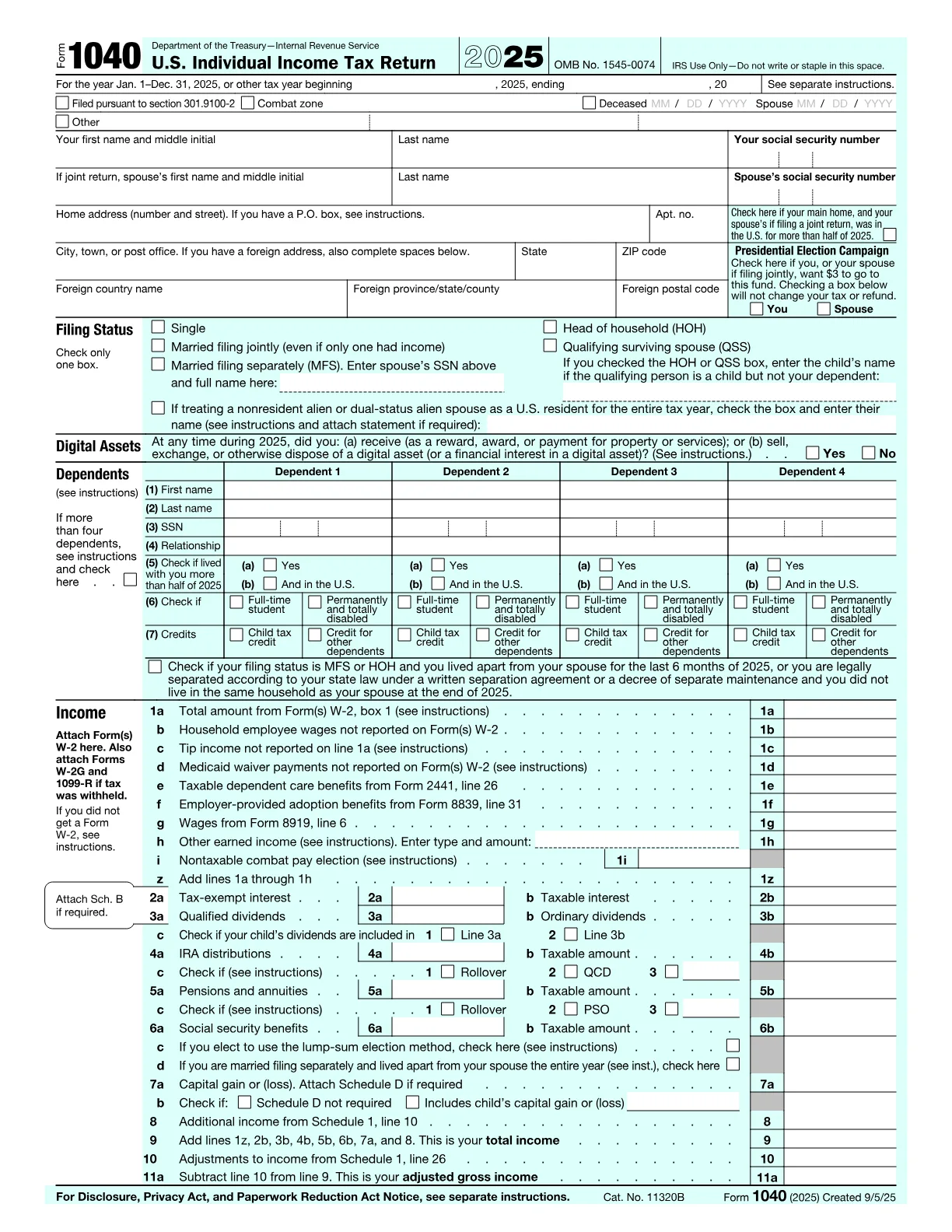
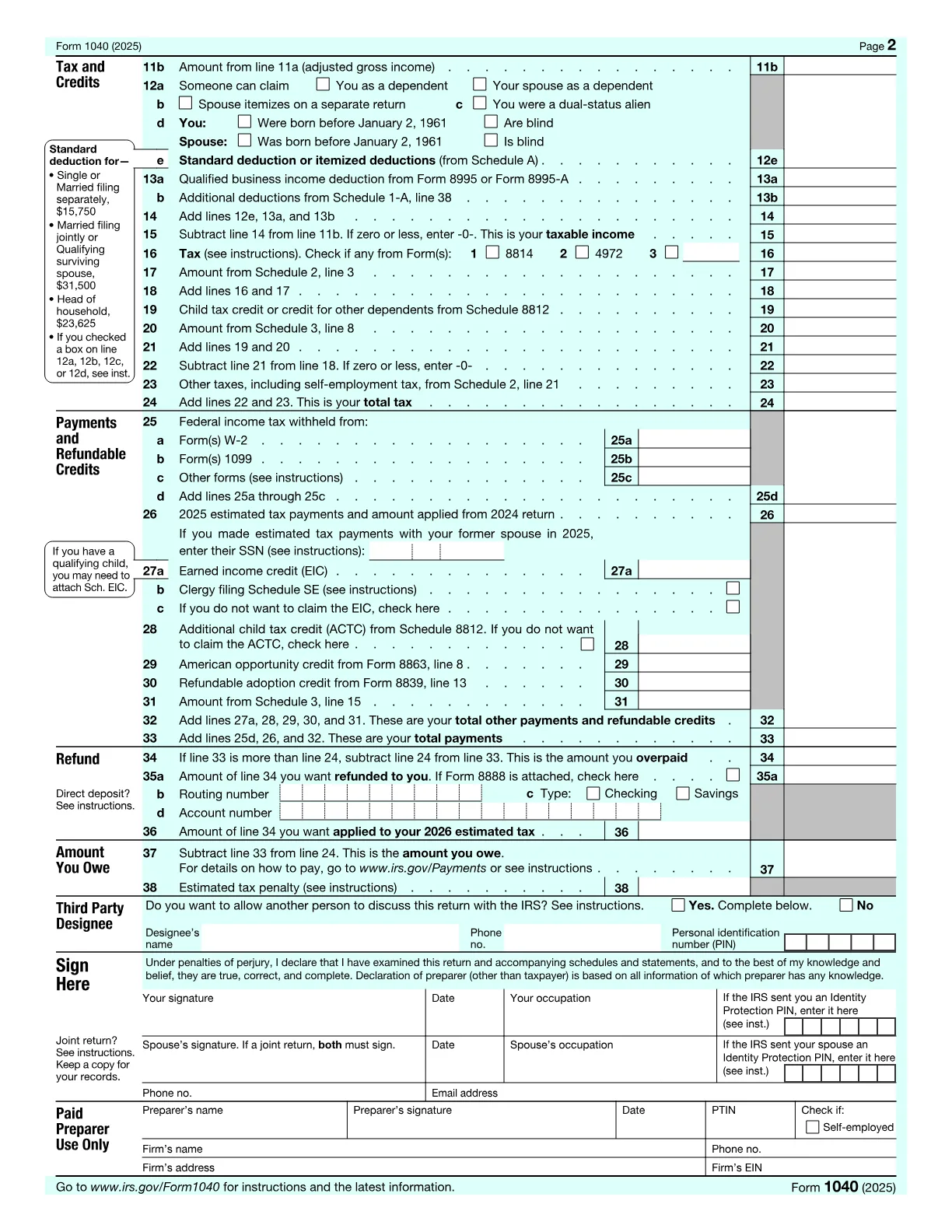
Every line, explained
No line matches that. Try a line number like 7a, or a word like pension.
Filing status, digital assets and dependents
StatusFiling status
Check one box: single, married filing jointly, married filing separately, head of household, or qualifying surviving spouse. Filing status sets the standard deduction, the tax brackets and who qualifies for many credits, so it is the first decision on every return.
Where it comes from: The taxpayer's marital status on December 31 and who lived with them during the year.
Digital assetsDigital assets question
Every return answers yes or no: did the taxpayer receive digital assets as a reward, award or payment, or sell, exchange or otherwise dispose of any? Simply holding them, or moving them between your own wallets, is a no.
Where it comes from: The taxpayer, and any Form 1099-DA or exchange statements.
DependentsDependents
Name, SSN and relationship for each dependent, whether they lived with the taxpayer for more than half the year, whether they were a full-time student or permanently disabled, and which credit they qualify for: the child tax credit or the credit for other dependents.
Where it comes from: Birth dates, SSN cards, school and residency records for each person claimed.
Income
1aTotal amount from Form(s) W-2, box 1
Wages from every W-2, added up. Box 1 is already reduced by pre-tax items such as traditional 401(k) deferrals and pre-tax health premiums, which is why it is often lower than boxes 3 and 5.
Where it comes from: Box 1 of each Form W-2.
Practice returns: 87 of the 114 practice returns fill in this line.
1b to 1iOther wage-type income
Earned income that is not in W-2 box 1: household employee wages with no W-2 (1b), tips not reported to the employer (1c), Medicaid waiver payments (1d), taxable dependent care benefits from Form 2441 (1e), employer adoption benefits from Form 8839 (1f), wages from Form 8919 (1g), and other earned income (1h). Line 1i is the nontaxable combat pay election, which can raise the earned income credit.
Where it comes from: The taxpayer's records, Forms 2441, 8839, 8919 and 4137.
Practice returns: none use this line yet. Request one.
1zAdd lines 1a through 1h
Total wages and wage-type income.
Where it comes from: Lines 1a to 1h.
Practice returns: 87 of the 114 practice returns fill in this line.
2aTax-exempt interest
Interest that is not taxed, usually from municipal bonds. It is still reported because it can make Social Security benefits taxable and enters other calculations.
Where it comes from: Form 1099-INT box 8, or 1099-DIV box 12 for exempt-interest dividends.
Practice returns that fill in this line (1):
2bTaxable interest
Interest from bank accounts, CDs, Treasury bonds and the like. If it is over $1,500, Schedule B lists each payer.
Where it comes from: Form 1099-INT boxes 1 and 3.
Practice returns that fill in this line (56):
- A personal loan to a friend goes bad
- Adoption credit and employer adoption benefits (Form 8839)
- Alabama: deducting federal income tax on Form 40
- Arkansas: the $6,000 retirement income exemption
- Backdoor Roth with last year's unconverted basis
- California: adding back the HSA deduction
- Capital loss carryover from last year
- Changed jobs mid-year: excess Social Security tax
- Colorado: starting from federal taxable income with a Schedule C
- Connecticut: CHET, the Tax Calculation Schedule, and the property tax credit
- Crypto sales on the first Form 1099-DA, plus staking rewards
- Delaware: the pension exclusion for a retiree under 65
- Dependent care FSA and the child care credit
- Dependent college student with a summer job
- Detroit renter: Michigan flat tax, the homestead property tax credit, and the city return
- District of Columbia investor: DC's own standard deduction and the out-of-state muni bond addback
- Early Roth IRA withdrawal: contributions first, then earnings
- First job, one W-2, a little interest
- Head of household through a parent who lives on her own
- Illinois retirees: retirement income subtraction and property tax credit
- Investor with dividends and stock sales
- Kentucky investor: Treasury interest subtraction and Louisville occupational tax
- Kiddie tax: a teenager's interest taxed at her parents' rate
- Laid off mid-year: unemployment and student loan interest
- Louisiana retiree: the $12,000 retirement exemption and the new 3% flat tax
- Married couple, two backdoor Roths, two Forms 8606
- Married couple, two W-2s and an HSA
- Massachusetts renter with a brokerage account: the rental deduction and the three income classes
- Missouri's new capital gain subtraction
- Montana fishing guide: federal taxable income without QBI
- Nebraska retirees: Social Security fully exempt
- New Jersey renter: property tax deduction or credit
- New York City residents with a 529 deduction
- No Tax on Car Loan Interest, phased out: the round-up rule
- No Tax on Tips, phased out: a high-earning Las Vegas bartender
- North Carolina flat tax and the child deduction
- Ohio: school district income tax, the 529 deduction, and the joint filing credit
- Oklahoma: child tax credit, sales tax relief, and an EIC under 2020 rules
- Oregon: the federal tax subtraction and the 2025 kicker for a freelancer
- Pennsylvania: PA wages, unreimbursed job expenses, and the Pittsburgh earned income tax
- Required minimum distribution with a qualified charitable distribution
- Retiree with Social Security and a pension
- RSU and ESPP sales: fixing the basis on Form 8949
- Seller-financed land sale on Form 6252
- Selling personal items online with a Form 1099-K
- Show-dog stud fees: hobby or business?
- Six K-1s, a partnership exit, and Section 1231
- Solar, a battery, and a heat pump: both home energy credits on Form 5695
- Sold the rental house: Section 1231, unrecaptured 1250 gain, and freed passive losses
- South Carolina: dependent exemptions, the under-6 deduction, Future Scholar, and the Two Wage Earner Credit
- Statutory employee: W-2 wages on Schedule C
- The $6,000 senior deduction: a retiree stacks it on the age-65 standard deduction
- The 2025 SALT cap: $40,000, reduced for high income
- The senior deduction, phased out: a retired couple both over 65
- West Virginia retiree: the 65% Social Security subtraction and the senior deduction it uses up
- Widowed parent filing as qualifying surviving spouse
3aQualified dividends
The part of ordinary dividends that gets the lower capital gains tax rates. It is already included in line 3b; it is shown separately so the tax can be figured at the right rate.
Where it comes from: Form 1099-DIV box 1b.
Practice returns that fill in this line (8):
- District of Columbia investor: DC's own standard deduction and the out-of-state muni bond addback
- Foreign dividends and the foreign tax credit
- Investor with dividends and stock sales
- Kentucky investor: Treasury interest subtraction and Louisville occupational tax
- Massachusetts renter with a brokerage account: the rental deduction and the three income classes
- Missouri's new capital gain subtraction
- North Dakota: the 40% exclusion for capital gains and qualified dividends
- Wages, a rental, and a brokerage account
3bOrdinary dividends
Total ordinary dividends. Over $1,500 means Schedule B. Capital gain distributions are not here; they go to line 7a or Schedule D.
Where it comes from: Form 1099-DIV box 1a.
Practice returns that fill in this line (8):
- District of Columbia investor: DC's own standard deduction and the out-of-state muni bond addback
- Foreign dividends and the foreign tax credit
- Investor with dividends and stock sales
- Kentucky investor: Treasury interest subtraction and Louisville occupational tax
- Massachusetts renter with a brokerage account: the rental deduction and the three income classes
- Missouri's new capital gain subtraction
- North Dakota: the 40% exclusion for capital gains and qualified dividends
- Wages, a rental, and a brokerage account
4a, 4bIRA distributions and taxable amount
The gross amount taken out of traditional, Roth, SEP and SIMPLE IRAs on 4a, and the taxable part on 4b. The checkboxes cover rollovers and qualified charitable distributions, which are not taxed. Roth conversions and IRAs with after-tax basis need Form 8606.
Where it comes from: Form 1099-R from the IRA custodian, and Form 8606.
Practice returns that fill in this line (16):
- Arkansas: the $6,000 retirement income exemption
- Backdoor Roth cleaned up by rolling the old IRA into the 401(k)
- Backdoor Roth conversion and the pro-rata rule
- Backdoor Roth plus an IRA withdrawal: pro-rata on both
- Backdoor Roth with last year's unconverted basis
- Delaware: the pension exclusion for a retiree under 65
- Early Roth IRA withdrawal: contributions first, then earnings
- Illinois retirees: retirement income subtraction and property tax credit
- Louisiana retiree: the $12,000 retirement exemption and the new 3% flat tax
- Married couple, two backdoor Roths, two Forms 8606
- Nebraska retirees: Social Security fully exempt
- Required minimum distribution with a qualified charitable distribution
- Retiree with Social Security and a pension
- The senior deduction, phased out: a retired couple both over 65
- Underpaid estimates and Form 2210
- West Virginia retiree: the 65% Social Security subtraction and the senior deduction it uses up
5a, 5bPensions and annuities and taxable amount
Payments from pensions, annuities and employer plans such as a 401(k), with the taxable part on 5b. An early distribution may also owe the additional 10% tax, which lands on Schedule 2.
Where it comes from: Form 1099-R from the plan.
Practice returns that fill in this line (11):
- Arkansas: the $6,000 retirement income exemption
- Delaware: the pension exclusion for a retiree under 65
- Early retirement withdrawal and the penalty
- Illinois retirees: retirement income subtraction and property tax credit
- Louisiana retiree: the $12,000 retirement exemption and the new 3% flat tax
- Nebraska retirees: Social Security fully exempt
- Required minimum distribution with a qualified charitable distribution
- Retiree with Social Security and a pension
- The $6,000 senior deduction: a retiree stacks it on the age-65 standard deduction
- The senior deduction, phased out: a retired couple both over 65
- West Virginia retiree: the 65% Social Security subtraction and the senior deduction it uses up
6a, 6bSocial Security benefits and taxable amount
Total benefits on 6a. Line 6b is the taxable part, from zero up to 85% of the benefits, depending on the taxpayer's other income. The Social Security Benefits Worksheet in the instructions does the math.
Where it comes from: Form SSA-1099 box 5.
Practice returns that fill in this line (9):
- Arkansas: the $6,000 retirement income exemption
- Delaware: the pension exclusion for a retiree under 65
- Illinois retirees: retirement income subtraction and property tax credit
- Louisiana retiree: the $12,000 retirement exemption and the new 3% flat tax
- Nebraska retirees: Social Security fully exempt
- Required minimum distribution with a qualified charitable distribution
- Retiree with Social Security and a pension
- The senior deduction, phased out: a retired couple both over 65
- West Virginia retiree: the 65% Social Security subtraction and the senior deduction it uses up
7aCapital gain or (loss)
Net gain or loss from selling stocks, funds, crypto and other capital assets, usually from Schedule D. A net loss is limited to $3,000 a year ($1,500 married filing separately), and the rest carries forward.
Where it comes from: Schedule D and Form 8949, built from Form 1099-B.
Practice returns that fill in this line (17):
- A personal loan to a friend goes bad
- Capital loss carryover from last year
- Crypto sales on the first Form 1099-DA, plus staking rewards
- District of Columbia investor: DC's own standard deduction and the out-of-state muni bond addback
- Investor with dividends and stock sales
- Kentucky investor: Treasury interest subtraction and Louisville occupational tax
- Massachusetts renter with a brokerage account: the rental deduction and the three income classes
- Missouri's new capital gain subtraction
- North Dakota: the 40% exclusion for capital gains and qualified dividends
- Pennsylvania: PA wages, unreimbursed job expenses, and the Pittsburgh earned income tax
- RSU and ESPP sales: fixing the basis on Form 8949
- Seller-financed land sale on Form 6252
- Selling personal items online with a Form 1099-K
- Six K-1s, a partnership exit, and Section 1231
- Sold an inherited house
- Sold the rental house: Section 1231, unrecaptured 1250 gain, and freed passive losses
- Wages, a rental, and a brokerage account
8Additional income from Schedule 1, line 10
Everything else that is taxable: business profit from Schedule C, rental and K-1 income from Schedule E, farm income, unemployment, gambling winnings, cancelled debt, taxable state refunds and more. Schedule 1 adds them up.
Where it comes from: Schedule 1, Part I.
Practice returns that fill in this line (28):
- Business meals: 50%, 100%, or nothing on Schedule C
- Cancelled debt (1099-C)
- Colorado: starting from federal taxable income with a Schedule C
- Consultant with a SEP-IRA
- Content creator with several income streams
- Crypto sales on the first Form 1099-DA, plus staking rewards
- Freelance designer with a home office
- Gambling winnings and losses
- HSA over-contribution and a non-medical withdrawal
- Independent contractor who expected a refund
- Iowa self-employed photographer: flat 3.8% tax and the school district surtax
- Laid off mid-year: unemployment and student loan interest
- Mississippi self-employed painter: Schedule C, commuting miles, SE tax, QBI, and a state that builds its own AGI
- Montana fishing guide: federal taxable income without QBI
- Online seller with inventory
- Oregon: the federal tax subtraction and the 2025 kicker for a freelancer
- Partner with a K-1 and guaranteed payments
- Real estate agent (Schedule C, actual vehicle expenses)
- Rental property with depreciation
- Rideshare and delivery driver (gig work)
- S corporation owner with a K-1 and payroll
- Show-dog stud fees: hobby or business?
- Six K-1s, a partnership exit, and Section 1231
- Small farm (Schedule F)
- Sold the rental house: Section 1231, unrecaptured 1250 gain, and freed passive losses
- Statutory employee: W-2 wages on Schedule C
- Virginia self-employed: Schedule C, estimates, and the $4,000 Virginia529 deduction
- Wages, a rental, and a brokerage account
9Total income
Lines 1z, 2b, 3b, 4b, 5b, 6b, 7a and 8 added together.
Where it comes from: The lines above.
Practice returns: every practice return fills in this line.
Adjusted gross income
10Adjustments to income from Schedule 1, line 26
Deductions taken before AGI, sometimes called above-the-line: half of self-employment tax, HSA contributions, SEP and solo 401(k) contributions, self-employed health insurance, student loan interest, educator expenses, deductible IRA contributions and others.
Where it comes from: Schedule 1, Part II, with Forms 8889, Schedule SE and the taxpayer's records.
Practice returns that fill in this line (24):
- Business meals: 50%, 100%, or nothing on Schedule C
- California: adding back the HSA deduction
- Colorado: starting from federal taxable income with a Schedule C
- Consultant with a SEP-IRA
- Content creator with several income streams
- Freelance designer with a home office
- HSA over-contribution and a non-medical withdrawal
- Independent contractor who expected a refund
- Iowa self-employed photographer: flat 3.8% tax and the school district surtax
- Laid off mid-year: unemployment and student loan interest
- Maine graduate paying off student loans: interest deduction plus the refundable repayment credit
- Married couple, two W-2s and an HSA
- Minister with a housing allowance
- Mississippi self-employed painter: Schedule C, commuting miles, SE tax, QBI, and a state that builds its own AGI
- Montana fishing guide: federal taxable income without QBI
- Online seller with inventory
- Oregon: the federal tax subtraction and the 2025 kicker for a freelancer
- Partner with a K-1 and guaranteed payments
- Real estate agent (Schedule C, actual vehicle expenses)
- Rideshare and delivery driver (gig work)
- Saver's Credit with a 401(k) and a traditional IRA
- Six K-1s, a partnership exit, and Section 1231
- Small farm (Schedule F)
- Virginia self-employed: Schedule C, estimates, and the $4,000 Virginia529 deduction
11a, 11bAdjusted gross income (AGI)
Total income minus adjustments. AGI is the number many limits key off: credits, phase-outs, medical expense floors. It ends page 1 on line 11a and is repeated at the top of page 2 on line 11b.
Where it comes from: Line 9 minus line 10.
Practice returns: every practice return fills in this line.
Deductions and taxable income
12a to 12dStandard deduction checkboxes
Boxes that change the standard deduction: someone can claim the taxpayer or spouse as a dependent, the spouse itemizes on a separate return, dual-status alien, and born before January 2, 1961 or blind. A dependent gets a smaller standard deduction; 65 or older or blind adds to it.
Where it comes from: Dates of birth and the taxpayer's situation.
12eStandard deduction or itemized deductions (from Schedule A)
The larger of the standard deduction or itemized deductions. For 2025 the standard deduction is $15,750 single, $31,500 married filing jointly and $23,625 head of household, before the extra amounts for age and blindness. Itemizing means Schedule A: mortgage interest, state and local taxes, charity and medical expenses over the floor.
Where it comes from: The standard deduction chart, or Schedule A.
Practice returns: every practice return fills in this line.
13aQualified business income deduction from Form 8995 or 8995-A
Up to 20% of qualified business income from a sole proprietorship, partnership or S corporation, limited by taxable income. It is taken whether or not the taxpayer itemizes.
Where it comes from: Form 8995 (or 8995-A above the income threshold).
Practice returns that fill in this line (19):
- Business meals: 50%, 100%, or nothing on Schedule C
- Colorado: starting from federal taxable income with a Schedule C
- Consultant with a SEP-IRA
- Content creator with several income streams
- Freelance designer with a home office
- Independent contractor who expected a refund
- Iowa self-employed photographer: flat 3.8% tax and the school district surtax
- Mississippi self-employed painter: Schedule C, commuting miles, SE tax, QBI, and a state that builds its own AGI
- Montana fishing guide: federal taxable income without QBI
- Online seller with inventory
- Oregon: the federal tax subtraction and the 2025 kicker for a freelancer
- Partner with a K-1 and guaranteed payments
- Real estate agent (Schedule C, actual vehicle expenses)
- Rideshare and delivery driver (gig work)
- S corporation owner with a K-1 and payroll
- Six K-1s, a partnership exit, and Section 1231
- Small farm (Schedule F)
- Statutory employee: W-2 wages on Schedule C
- Virginia self-employed: Schedule C, estimates, and the $4,000 Virginia529 deduction
13bAdditional deductions from Schedule 1-A, line 38New for 2025
The new 2025 deductions, each on its own part of Schedule 1-A and each available with the standard deduction or itemizing: qualified tips up to $25,000; qualified overtime up to $12,500 ($25,000 married filing jointly), both phasing out above $150,000 of modified AGI ($300,000 jointly); interest on a loan for a new US-assembled vehicle up to $10,000, phasing out above $100,000 ($200,000 jointly); and $6,000 for each taxpayer 65 or older, reduced by 6% of modified AGI over $75,000 ($150,000 jointly).
Where it comes from: Schedule 1-A, line 38.
Practice returns that fill in this line (15):
- Arkansas: the $6,000 retirement income exemption
- Illinois retirees: retirement income subtraction and property tax credit
- Louisiana retiree: the $12,000 retirement exemption and the new 3% flat tax
- Nebraska retirees: Social Security fully exempt
- No Tax on Car Loan Interest, phased out: the round-up rule
- No Tax on Car Loan Interest: a new US-assembled car bought in 2025
- No Tax on Overtime, phased out: a Wyoming lineworker over the threshold
- No Tax on Overtime: a warehouse worker deducts the overtime premium
- No Tax on Tips, phased out: a high-earning Las Vegas bartender
- No Tax on Tips: a restaurant server claims the new 2025 tip deduction
- Required minimum distribution with a qualified charitable distribution
- Retiree with Social Security and a pension
- The $6,000 senior deduction: a retiree stacks it on the age-65 standard deduction
- The senior deduction, phased out: a retired couple both over 65
- West Virginia retiree: the 65% Social Security subtraction and the senior deduction it uses up
14Add lines 12e, 13a and 13b
Total deductions.
Where it comes from: The lines above.
Practice returns: every practice return fills in this line.
15Taxable income
AGI minus total deductions, never below zero. This is what the tax rates apply to.
Where it comes from: Line 11b minus line 14.
Practice returns: 108 of the 114 practice returns fill in this line.
Tax and credits
16Tax
The regular income tax. Under $100,000 of taxable income it comes from the Tax Table, which taxes the midpoint of each small income band rather than the exact amount. With qualified dividends or long-term gains, the Qualified Dividends and Capital Gain Tax Worksheet applies the lower rates. Checkboxes flag Form 8814 (a child's interest and dividends) and Form 4972 (lump-sum distributions).
Where it comes from: The Tax Table, the Tax Computation Worksheet, or the capital gains worksheet.
Practice returns: 108 of the 114 practice returns fill in this line.
17Amount from Schedule 2, line 3
Alternative minimum tax and repayment of excess advance premium tax credit.
Where it comes from: Schedule 2, Part I, with Forms 6251 and 8962.
Practice returns: none use this line yet. Request one.
18Add lines 16 and 17
Tax before credits.
Where it comes from: The lines above.
Practice returns: 108 of the 114 practice returns fill in this line.
19Child tax credit or credit for other dependents from Schedule 8812
The nonrefundable child tax credit, $2,200 per qualifying child for 2025, plus the credit for other dependents. It phases out above $200,000 of modified AGI ($400,000 married filing jointly). Any part that can't be used here may come back as the refundable additional child tax credit on line 28.
Where it comes from: Schedule 8812.
Practice returns that fill in this line (17):
- Adoption credit and employer adoption benefits (Form 8839)
- Alabama: deducting federal income tax on Form 40
- Connecticut: CHET, the Tax Calculation Schedule, and the property tax credit
- Dependent care FSA and the child care credit
- Georgia family: Path2College 529 subtraction, dependent exemptions, and the 50% child care credit
- Head of household through a parent who lives on her own
- Household employer (the nanny tax)
- Idaho single parent: flat 5.3% tax, child tax credit, and food tax credit
- Kansas family: Learning Quest 529 subtraction and Kansas exemptions
- Maryland couple in Howard County: county tax, the two-income subtraction, and two 529 subtractions
- North Carolina flat tax and the child deduction
- Ohio: school district income tax, the 529 deduction, and the joint filing credit
- Rhode Island: the standard deduction and exemption phase-out for a high-earning couple
- Single parent, one child, Child Tax Credit
- South Carolina: dependent exemptions, the under-6 deduction, Future Scholar, and the Two Wage Earner Credit
- Utah taxpayer tax credit, my529 credit, and the Utah child tax credit
- Widowed parent filing as qualifying surviving spouse
20Amount from Schedule 3, line 8
Other nonrefundable credits: the foreign tax credit, child and dependent care credit, education credits, the saver's credit, energy credits and others.
Where it comes from: Schedule 3, Part I, with Forms 1116, 2441, 8863, 8880 and more.
Practice returns that fill in this line (8):
- Adoption credit and employer adoption benefits (Form 8839)
- Dependent care FSA and the child care credit
- Foreign dividends and the foreign tax credit
- Georgia family: Path2College 529 subtraction, dependent exemptions, and the 50% child care credit
- Graduate student with the Lifetime Learning Credit
- Saver's Credit with a 401(k) and a traditional IRA
- Solar, a battery, and a heat pump: both home energy credits on Form 5695
- Working student with an education credit
21Add lines 19 and 20
Total nonrefundable credits.
Where it comes from: The lines above.
Practice returns that fill in this line (22):
- Adoption credit and employer adoption benefits (Form 8839)
- Alabama: deducting federal income tax on Form 40
- Connecticut: CHET, the Tax Calculation Schedule, and the property tax credit
- Dependent care FSA and the child care credit
- Foreign dividends and the foreign tax credit
- Georgia family: Path2College 529 subtraction, dependent exemptions, and the 50% child care credit
- Graduate student with the Lifetime Learning Credit
- Head of household through a parent who lives on her own
- Household employer (the nanny tax)
- Idaho single parent: flat 5.3% tax, child tax credit, and food tax credit
- Kansas family: Learning Quest 529 subtraction and Kansas exemptions
- Maryland couple in Howard County: county tax, the two-income subtraction, and two 529 subtractions
- North Carolina flat tax and the child deduction
- Ohio: school district income tax, the 529 deduction, and the joint filing credit
- Rhode Island: the standard deduction and exemption phase-out for a high-earning couple
- Saver's Credit with a 401(k) and a traditional IRA
- Single parent, one child, Child Tax Credit
- Solar, a battery, and a heat pump: both home energy credits on Form 5695
- South Carolina: dependent exemptions, the under-6 deduction, Future Scholar, and the Two Wage Earner Credit
- Utah taxpayer tax credit, my529 credit, and the Utah child tax credit
- Widowed parent filing as qualifying surviving spouse
- Working student with an education credit
22Subtract line 21 from line 18
Tax after nonrefundable credits, never below zero.
Where it comes from: The lines above.
Practice returns: 107 of the 114 practice returns fill in this line.
23Other taxes, including self-employment tax, from Schedule 2, line 21
Taxes beyond income tax: self-employment tax, household employment (nanny) taxes, the additional 10% tax on early retirement distributions, the Additional Medicare Tax, the net investment income tax and others.
Where it comes from: Schedule 2, Part II, with Schedule SE, Schedule H, Form 5329 and others.
Practice returns that fill in this line (27):
- Business meals: 50%, 100%, or nothing on Schedule C
- Changed jobs mid-year: excess Social Security tax
- Colorado: starting from federal taxable income with a Schedule C
- Consultant with a SEP-IRA
- Content creator with several income streams
- Early retirement withdrawal and the penalty
- Early Roth IRA withdrawal: contributions first, then earnings
- Freelance designer with a home office
- Household employer (the nanny tax)
- HSA over-contribution and a non-medical withdrawal
- Independent contractor who expected a refund
- Iowa self-employed photographer: flat 3.8% tax and the school district surtax
- Married couple, two backdoor Roths, two Forms 8606
- Minister with a housing allowance
- Mississippi self-employed painter: Schedule C, commuting miles, SE tax, QBI, and a state that builds its own AGI
- Montana fishing guide: federal taxable income without QBI
- Online seller with inventory
- Oregon: the federal tax subtraction and the 2025 kicker for a freelancer
- Partner with a K-1 and guaranteed payments
- Real estate agent (Schedule C, actual vehicle expenses)
- Rhode Island: the standard deduction and exemption phase-out for a high-earning couple
- Rideshare and delivery driver (gig work)
- Six K-1s, a partnership exit, and Section 1231
- Small farm (Schedule F)
- Sold the rental house: Section 1231, unrecaptured 1250 gain, and freed passive losses
- The 2025 SALT cap: $40,000, reduced for high income
- Virginia self-employed: Schedule C, estimates, and the $4,000 Virginia529 deduction
24Total tax
Everything the taxpayer owes for the year before payments.
Where it comes from: Line 22 plus line 23.
Practice returns: 107 of the 114 practice returns fill in this line.
Payments
25aFederal income tax withheld from Form(s) W-2
Income tax the employer withheld from pay.
Where it comes from: Box 2 of each Form W-2.
Practice returns: 85 of the 114 practice returns fill in this line.
25bFederal income tax withheld from Form(s) 1099
Withholding on 1099s: retirement distributions, unemployment, gambling winnings and backup withholding.
Where it comes from: Form 1099-R box 4, 1099-G box 4, W-2G box 4 and others.
Practice returns that fill in this line (13):
- Arkansas: the $6,000 retirement income exemption
- Backdoor Roth plus an IRA withdrawal: pro-rata on both
- Delaware: the pension exclusion for a retiree under 65
- Early retirement withdrawal and the penalty
- Illinois retirees: retirement income subtraction and property tax credit
- Laid off mid-year: unemployment and student loan interest
- Louisiana retiree: the $12,000 retirement exemption and the new 3% flat tax
- Nebraska retirees: Social Security fully exempt
- Required minimum distribution with a qualified charitable distribution
- Retiree with Social Security and a pension
- The $6,000 senior deduction: a retiree stacks it on the age-65 standard deduction
- The senior deduction, phased out: a retired couple both over 65
- West Virginia retiree: the 65% Social Security subtraction and the senior deduction it uses up
25c, 25dOther withholding and total withholding
Other withholding, such as Additional Medicare Tax withheld (Form 8959), on 25c; total withholding on 25d.
Where it comes from: Form 8959 and the lines above.
Practice returns: 94 of the 114 practice returns fill in this line.
262025 estimated tax payments and amount applied from 2024 return
Quarterly estimated payments for the year, plus any 2024 overpayment the taxpayer chose to apply to 2025.
Where it comes from: IRS payment records, Form 1040-ES vouchers, and last year's return.
Practice returns that fill in this line (20):
- Business meals: 50%, 100%, or nothing on Schedule C
- Colorado: starting from federal taxable income with a Schedule C
- Consultant with a SEP-IRA
- Content creator with several income streams
- Freelance designer with a home office
- Iowa self-employed photographer: flat 3.8% tax and the school district surtax
- Minister with a housing allowance
- Mississippi self-employed painter: Schedule C, commuting miles, SE tax, QBI, and a state that builds its own AGI
- Montana fishing guide: federal taxable income without QBI
- Online seller with inventory
- Oregon: the federal tax subtraction and the 2025 kicker for a freelancer
- Partner with a K-1 and guaranteed payments
- Real estate agent (Schedule C, actual vehicle expenses)
- Rideshare and delivery driver (gig work)
- S corporation owner with a K-1 and payroll
- Six K-1s, a partnership exit, and Section 1231
- Small farm (Schedule F)
- Sold the rental house: Section 1231, unrecaptured 1250 gain, and freed passive losses
- Statutory employee: W-2 wages on Schedule C
- Virginia self-employed: Schedule C, estimates, and the $4,000 Virginia529 deduction
27aEarned income credit (EIC)
A refundable credit for working people with low to moderate income. For 2025 it reaches $649 with no qualifying children and $4,328, $7,152 or $8,046 with one, two, or three or more. Investment income over $11,950 disqualifies it.
Where it comes from: The EIC worksheet and Schedule EIC if there are qualifying children.
Practice returns that fill in this line (5):
- Lower-income single parent (EITC)
- Minnesota family on a modest income: federal EITC and ACTC, then Minnesota's Child and Working Family Credits
- New Mexico single parent: refundable credits stack up
- Oklahoma: child tax credit, sales tax relief, and an EIC under 2020 rules
- Vermont refundable credits: child tax credit and the 38% state EITC
28Additional child tax credit (ACTC) from Schedule 8812
The refundable part of the child tax credit, up to $1,700 per child for 2025, for families whose tax is too low to use the full credit on line 19.
Where it comes from: Schedule 8812, Part II.
Practice returns that fill in this line (5):
- Lower-income single parent (EITC)
- Minnesota family on a modest income: federal EITC and ACTC, then Minnesota's Child and Working Family Credits
- New Mexico single parent: refundable credits stack up
- Oklahoma: child tax credit, sales tax relief, and an EIC under 2020 rules
- Vermont refundable credits: child tax credit and the 38% state EITC
29American opportunity credit from Form 8863, line 8
The refundable part, 40%, of the American opportunity credit for college costs.
Where it comes from: Form 8863 and Form 1098-T.
Practice returns that fill in this line (1):
30Refundable adoption credit from Form 8839, line 13
The refundable part of the adoption credit.
Where it comes from: Form 8839.
Practice returns that fill in this line (1):
31Amount from Schedule 3, line 15
Other payments and refundable credits, such as the net premium tax credit from Form 8962 and excess Social Security withheld by more than one employer.
Where it comes from: Schedule 3, Part II.
Practice returns that fill in this line (2):
32, 33Total refundable credits and total payments
Line 32 adds the refundable credits; line 33 adds withholding, estimated payments and refundable credits.
Where it comes from: The lines above.
Practice returns: 112 of the 114 practice returns fill in this line.
Refund or amount you owe
34, 35aAmount overpaid and amount refunded
If payments are more than the total tax, the difference is the overpayment. Line 35a is the part refunded; direct deposit takes the routing and account numbers on 35b to 35d, and Form 8888 splits it between accounts.
Where it comes from: Line 33 minus line 24.
Practice returns that fill in this line (74):
- A personal loan to a friend goes bad
- Adoption credit and employer adoption benefits (Form 8839)
- Alabama: deducting federal income tax on Form 40
- Arkansas: the $6,000 retirement income exemption
- Backdoor Roth cleaned up by rolling the old IRA into the 401(k)
- Backdoor Roth plus an IRA withdrawal: pro-rata on both
- Cancelled debt (1099-C)
- Capital loss carryover from last year
- Changed jobs mid-year: excess Social Security tax
- Connecticut: CHET, the Tax Calculation Schedule, and the property tax credit
- Delaware: the pension exclusion for a retiree under 65
- Dependent care FSA and the child care credit
- Dependent college student with a summer job
- Detroit renter: Michigan flat tax, the homestead property tax credit, and the city return
- District of Columbia investor: DC's own standard deduction and the out-of-state muni bond addback
- Early retirement withdrawal and the penalty
- First job, one W-2, a little interest
- Georgia family: Path2College 529 subtraction, dependent exemptions, and the 50% child care credit
- Graduate student with the Lifetime Learning Credit
- Hawaii renter: food/excise tax credit and renters credit
- Head of household through a parent who lives on her own
- Homeowner who itemizes deductions
- Household employer (the nanny tax)
- HSA over-contribution and a non-medical withdrawal
- Idaho single parent: flat 5.3% tax, child tax credit, and food tax credit
- Illinois retirees: retirement income subtraction and property tax credit
- Indiana renter: county tax and the renter's deduction
- Kansas family: Learning Quest 529 subtraction and Kansas exemptions
- Kentucky investor: Treasury interest subtraction and Louisville occupational tax
- Laid off mid-year: unemployment and student loan interest
- Louisiana retiree: the $12,000 retirement exemption and the new 3% flat tax
- Lower-income single parent (EITC)
- Maine graduate paying off student loans: interest deduction plus the refundable repayment credit
- Marketplace insurance and the premium tax credit
- Married couple, two W-2s and an HSA
- Maryland couple in Howard County: county tax, the two-income subtraction, and two 529 subtractions
- Maryland couple who itemize below the federal standard deduction to cut their state tax
- Massachusetts renter with a brokerage account: the rental deduction and the three income classes
- Minnesota family on a modest income: federal EITC and ACTC, then Minnesota's Child and Working Family Credits
- Moved to a new state mid-year
- Nebraska retirees: Social Security fully exempt
- New Jersey renter: property tax deduction or credit
- New Mexico single parent: refundable credits stack up
- New York City residents with a 529 deduction
- Newlyweds filing jointly for the first time
- No Tax on Car Loan Interest, phased out: the round-up rule
- No Tax on Car Loan Interest: a new US-assembled car bought in 2025
- No Tax on Overtime: a warehouse worker deducts the overtime premium
- No Tax on Tips, phased out: a high-earning Las Vegas bartender
- No Tax on Tips: a restaurant server claims the new 2025 tip deduction
- North Carolina flat tax and the child deduction
- Ohio: school district income tax, the 529 deduction, and the joint filing credit
- Oklahoma: child tax credit, sales tax relief, and an EIC under 2020 rules
- Pennsylvania: PA wages, unreimbursed job expenses, and the Pittsburgh earned income tax
- Rental property with depreciation
- Retiree with Social Security and a pension
- Rhode Island: the standard deduction and exemption phase-out for a high-earning couple
- RSU and ESPP sales: fixing the basis on Form 8949
- Saver's Credit with a 401(k) and a traditional IRA
- Selling personal items online with a Form 1099-K
- Single parent, one child, Child Tax Credit
- Solar, a battery, and a heat pump: both home energy credits on Form 5695
- Sold a primary home
- Sold an inherited house
- South Carolina: dependent exemptions, the under-6 deduction, Future Scholar, and the Two Wage Earner Credit
- Statutory employee: W-2 wages on Schedule C
- The $6,000 senior deduction: a retiree stacks it on the age-65 standard deduction
- The senior deduction, phased out: a retired couple both over 65
- Utah taxpayer tax credit, my529 credit, and the Utah child tax credit
- Vermont refundable credits: child tax credit and the 38% state EITC
- West Virginia retiree: the 65% Social Security subtraction and the senior deduction it uses up
- Widowed parent filing as qualifying surviving spouse
- Wisconsin renter: sliding standard deduction and the renter's school property tax credit
- Working student with an education credit
36Amount applied to your 2026 estimated tax
The part of the overpayment kept by the IRS as a first payment toward next year.
Where it comes from: The taxpayer's choice.
Practice returns: none use this line yet. Request one.
37Amount you owe
If the total tax is more than payments, this is the balance due, payable with Form 1040-V or electronically.
Where it comes from: Line 24 minus line 33.
Practice returns that fill in this line (40):
- Arizona: charitable tax credits and the increased standard deduction
- Backdoor Roth conversion and the pro-rata rule
- Backdoor Roth with last year's unconverted basis
- Business meals: 50%, 100%, or nothing on Schedule C
- California: adding back the HSA deduction
- Colorado: starting from federal taxable income with a Schedule C
- Consultant with a SEP-IRA
- Content creator with several income streams
- Crypto sales on the first Form 1099-DA, plus staking rewards
- Early Roth IRA withdrawal: contributions first, then earnings
- Foreign dividends and the foreign tax credit
- Freelance designer with a home office
- Gambling winnings and losses
- Independent contractor who expected a refund
- Investor with dividends and stock sales
- Iowa self-employed photographer: flat 3.8% tax and the school district surtax
- Kiddie tax: a teenager's interest taxed at her parents' rate
- Married couple, two backdoor Roths, two Forms 8606
- Minister with a housing allowance
- Mississippi self-employed painter: Schedule C, commuting miles, SE tax, QBI, and a state that builds its own AGI
- Missouri's new capital gain subtraction
- Montana fishing guide: federal taxable income without QBI
- No Tax on Overtime, phased out: a Wyoming lineworker over the threshold
- North Dakota: the 40% exclusion for capital gains and qualified dividends
- Online seller with inventory
- Oregon: the federal tax subtraction and the 2025 kicker for a freelancer
- Partner with a K-1 and guaranteed payments
- Real estate agent (Schedule C, actual vehicle expenses)
- Required minimum distribution with a qualified charitable distribution
- Rideshare and delivery driver (gig work)
- S corporation owner with a K-1 and payroll
- Seller-financed land sale on Form 6252
- Show-dog stud fees: hobby or business?
- Six K-1s, a partnership exit, and Section 1231
- Small farm (Schedule F)
- Sold the rental house: Section 1231, unrecaptured 1250 gain, and freed passive losses
- The 2025 SALT cap: $40,000, reduced for high income
- Underpaid estimates and Form 2210
- Virginia self-employed: Schedule C, estimates, and the $4,000 Virginia529 deduction
- Wages, a rental, and a brokerage account
38Estimated tax penalty
The penalty for paying too little tax during the year, through withholding or estimated payments. It is figured on Form 2210, which also has the exceptions that avoid it.
Where it comes from: Form 2210.
Practice returns that fill in this line (3):
New for 2025: line 13b and Schedule 1-A carry the One Big Beautiful Bill Act deductions for tips, overtime, car loan interest and seniors. Practice returns built around each one.
The schedules, line by line
The same interactive treatment for each schedule that feeds Form 1040:
- Schedule 1: additional income and adjustments to income (lines 8 and 10)
- Schedule 1-A: the new 2025 deductions for tips, overtime, car loan interest and seniors (line 13b)
- Schedule 2: additional taxes (lines 17 and 23)
- Schedule 3: additional credits and payments (lines 20 and 31)
- Schedule A: itemized deductions (line 12e)
- Schedule B: interest and ordinary dividends (lines 2b and 3b)
- Schedule C: profit or loss from a business
- Schedule D: capital gains and losses (line 7a)
- Schedule SE: self-employment tax
Practice the whole form
Reading a line is one thing; landing on the right number from a stack of documents is another. Every practice return gives you a taxpayer, their W-2s, 1099s and other documents, and an answer key to check your Form 1040 against. Start with the dependent college student, which is free from start to finish, or browse every scenario by difficulty.
FAQ
What changed on the 2025 Form 1040?
The biggest change is line 13b, which brings in the new Schedule 1-A deductions for qualified tips, qualified overtime, car loan interest and the senior deduction. The standard deduction also went up, to $15,750 single, $31,500 married filing jointly and $23,625 head of household.
Where is adjusted gross income on Form 1040?
Line 11a, at the bottom of page 1. The same amount is repeated on line 11b at the top of page 2.
Where is taxable income on Form 1040?
Line 15: adjusted gross income minus the standard or itemized deduction, the qualified business income deduction and the Schedule 1-A deductions.
Can I practice filling out a Form 1040?
Yes. Each practice return on this site gives you a fictional taxpayer's facts and documents to prepare a Form 1040 from, in any tax software or by hand, with an answer key to check your work.