Schedule C reports the income and expenses of a business run as a sole proprietor, including a single-member LLC, gig and freelance work reported on Forms 1099-NEC and 1099-K, and a statutory employee's W-2 income. Its net profit flows to Schedule 1 and to Schedule SE for self-employment tax. Tap any line on the 2025 form below to see what goes there.
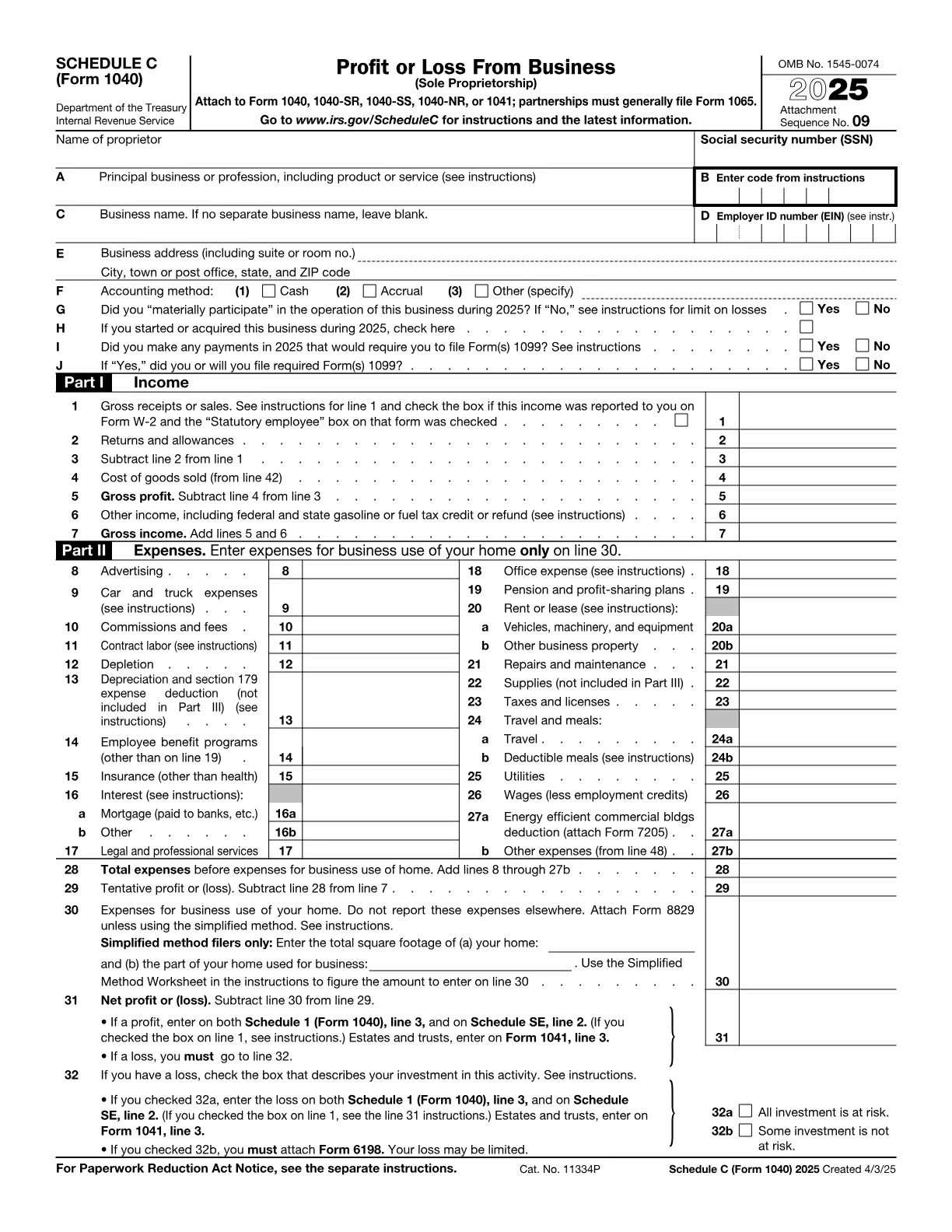
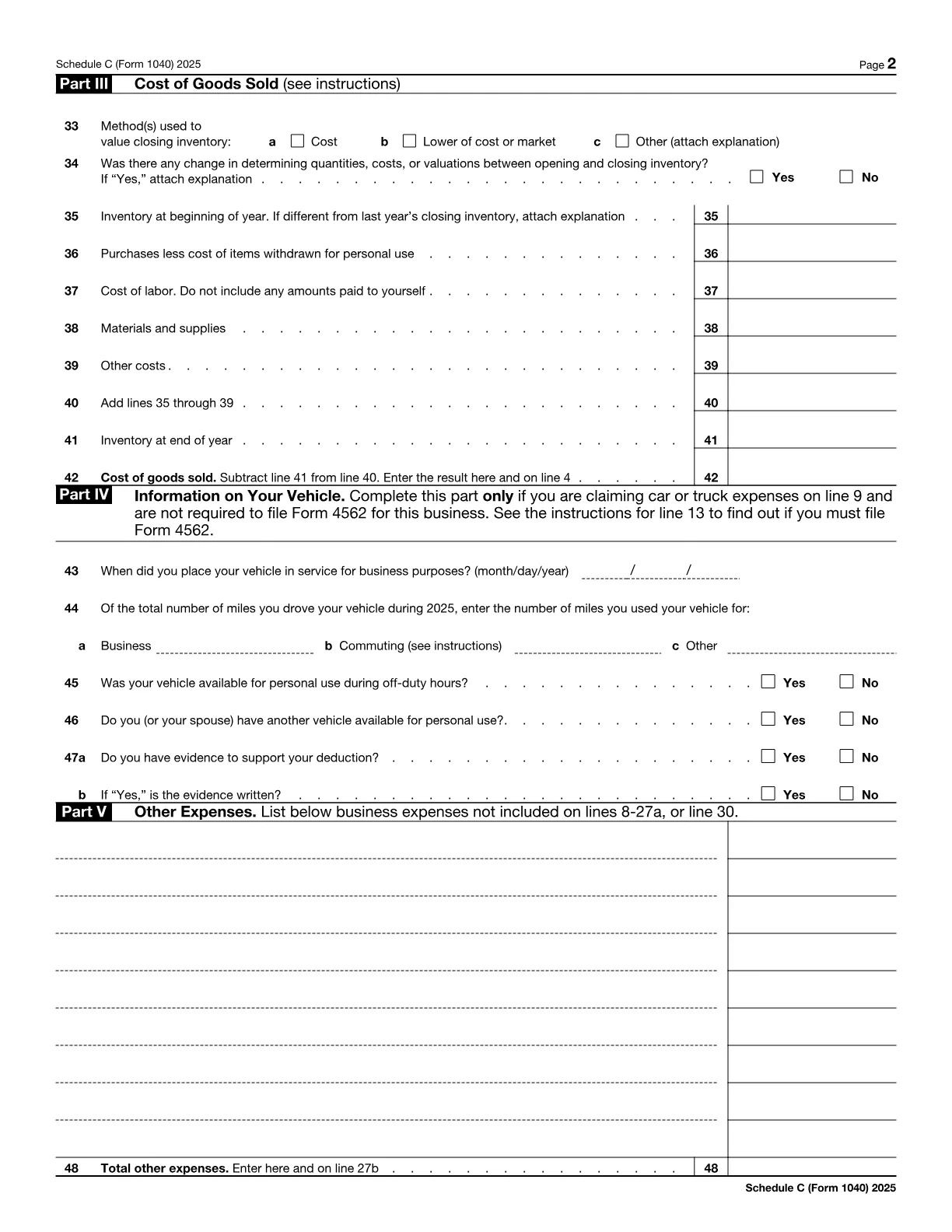
Every line, explained
No line matches that. Try a line number like 13, or a word like rent.
Business information (lines A to J)
A, BPrincipal business or profession, and business code
Line A describes the main activity and its product or service, for example "appraisal of real estate for lending institutions". Line B is the six-digit Principal Business or Professional Activity code from the chart at the end of the instructions. Each separate business gets its own Schedule C.
Where it comes from: The taxpayer, and the activity code chart in the Schedule C instructions.
Practice returns that fill in this line (16):
- Business meals: 50%, 100%, or nothing on Schedule C
- Colorado: starting from federal taxable income with a Schedule C
- Consultant with a SEP-IRA
- Content creator with several income streams
- Freelance designer with a home office
- Independent contractor who expected a refund
- Iowa self-employed photographer: flat 3.8% tax and the school district surtax
- Mississippi self-employed painter: Schedule C, commuting miles, SE tax, QBI, and a state that builds its own AGI
- Montana fishing guide: federal taxable income without QBI
- Online seller with inventory
- Oregon: the federal tax subtraction and the 2025 kicker for a freelancer
- Real estate agent (Schedule C, actual vehicle expenses)
- Rideshare and delivery driver (gig work)
- Six K-1s, a partnership exit, and Section 1231
- Statutory employee: W-2 wages on Schedule C
- Virginia self-employed: Schedule C, estimates, and the $4,000 Virginia529 deduction
CBusiness name
The business name, if it has one separate from the owner's name. Otherwise leave it blank.
Where it comes from: The taxpayer's business registration or trade name filing.
Practice returns that fill in this line (13):
- Business meals: 50%, 100%, or nothing on Schedule C
- Colorado: starting from federal taxable income with a Schedule C
- Consultant with a SEP-IRA
- Content creator with several income streams
- Freelance designer with a home office
- Independent contractor who expected a refund
- Iowa self-employed photographer: flat 3.8% tax and the school district surtax
- Mississippi self-employed painter: Schedule C, commuting miles, SE tax, QBI, and a state that builds its own AGI
- Montana fishing guide: federal taxable income without QBI
- Online seller with inventory
- Oregon: the federal tax subtraction and the 2025 kicker for a freelancer
- Six K-1s, a partnership exit, and Section 1231
- Virginia self-employed: Schedule C, estimates, and the $4,000 Virginia529 deduction
DEmployer ID number (EIN)
The EIN the IRS issued to the business, if it has one. Never the owner's SSN and never a payer's EIN copied from a Form 1099. A sole proprietor needs an EIN only for things like a qualified retirement plan or employment and excise tax returns; without one, the line stays blank.
Where it comes from: The EIN the IRS issued on Form SS-4.
Practice returns that fill in this line (2):
EBusiness address
A street address, not a post office box. It can be skipped if the business is run from the home address shown on Form 1040.
Where it comes from: The taxpayer.
Practice returns that fill in this line (1):
FAccounting method
Cash, accrual or other. Under the cash method, income counts when it is actually or constructively received and expenses when they are paid. Whatever the method, it must clearly reflect income, and changing it generally takes Form 3115.
Where it comes from: How the taxpayer keeps the books.
Practice returns that fill in this line (16):
- Business meals: 50%, 100%, or nothing on Schedule C
- Colorado: starting from federal taxable income with a Schedule C
- Consultant with a SEP-IRA
- Content creator with several income streams
- Freelance designer with a home office
- Independent contractor who expected a refund
- Iowa self-employed photographer: flat 3.8% tax and the school district surtax
- Mississippi self-employed painter: Schedule C, commuting miles, SE tax, QBI, and a state that builds its own AGI
- Montana fishing guide: federal taxable income without QBI
- Online seller with inventory
- Oregon: the federal tax subtraction and the 2025 kicker for a freelancer
- Real estate agent (Schedule C, actual vehicle expenses)
- Rideshare and delivery driver (gig work)
- Six K-1s, a partnership exit, and Section 1231
- Statutory employee: W-2 wages on Schedule C
- Virginia self-employed: Schedule C, estimates, and the $4,000 Virginia529 deduction
GDid you "materially participate" in the operation of this business during 2025?
Yes if the owner meets any of the seven material participation tests in the instructions, the most common being more than 500 hours in the activity during the year. No makes the business a passive activity, and a passive loss may be limited on Form 8582.
Where it comes from: The owner's hours and role in the business.
Practice returns that fill in this line (16):
- Business meals: 50%, 100%, or nothing on Schedule C
- Colorado: starting from federal taxable income with a Schedule C
- Consultant with a SEP-IRA
- Content creator with several income streams
- Freelance designer with a home office
- Independent contractor who expected a refund
- Iowa self-employed photographer: flat 3.8% tax and the school district surtax
- Mississippi self-employed painter: Schedule C, commuting miles, SE tax, QBI, and a state that builds its own AGI
- Montana fishing guide: federal taxable income without QBI
- Online seller with inventory
- Oregon: the federal tax subtraction and the 2025 kicker for a freelancer
- Real estate agent (Schedule C, actual vehicle expenses)
- Rideshare and delivery driver (gig work)
- Six K-1s, a partnership exit, and Section 1231
- Statutory employee: W-2 wages on Schedule C
- Virginia self-employed: Schedule C, estimates, and the $4,000 Virginia529 deduction
HIf you started or acquired this business during 2025, check here
Check it for a business started or bought in 2025, or one reopened after a temporary closing with no 2024 Schedule C filed for it.
Where it comes from: The taxpayer.
Practice returns: none use this line yet. Request one.
I, JPayments that require Forms 1099, and whether they were filed
Line I asks whether the business made payments in 2025 that require filing Forms 1099, for example $600 or more of contract labor reported on Form 1099-NEC. Line J asks whether the required forms were or will be filed.
Where it comes from: The taxpayer's payment records and any Forms 1099 the business filed.
Practice returns that fill in this line (16):
- Business meals: 50%, 100%, or nothing on Schedule C
- Colorado: starting from federal taxable income with a Schedule C
- Consultant with a SEP-IRA
- Content creator with several income streams
- Freelance designer with a home office
- Independent contractor who expected a refund
- Iowa self-employed photographer: flat 3.8% tax and the school district surtax
- Mississippi self-employed painter: Schedule C, commuting miles, SE tax, QBI, and a state that builds its own AGI
- Montana fishing guide: federal taxable income without QBI
- Online seller with inventory
- Oregon: the federal tax subtraction and the 2025 kicker for a freelancer
- Real estate agent (Schedule C, actual vehicle expenses)
- Rideshare and delivery driver (gig work)
- Six K-1s, a partnership exit, and Section 1231
- Statutory employee: W-2 wages on Schedule C
- Virginia self-employed: Schedule C, estimates, and the $4,000 Virginia529 deduction
Part I: Income
1Gross receipts or sales
All the income of the business, including everything reported on Forms 1099-NEC, 1099-MISC and 1099-K. If the 1099-NEC box 1 totals are more than line 1, attach a statement explaining the difference. A statutory employee enters W-2 box 1 here and checks the box; that income gets its own Schedule C and no self-employment tax.
Where it comes from: Sales records, Forms 1099-NEC, 1099-K and 1099-MISC, and W-2 box 1 for a statutory employee.
Practice returns that fill in this line (16):
- Business meals: 50%, 100%, or nothing on Schedule C
- Colorado: starting from federal taxable income with a Schedule C
- Consultant with a SEP-IRA
- Content creator with several income streams
- Freelance designer with a home office
- Independent contractor who expected a refund
- Iowa self-employed photographer: flat 3.8% tax and the school district surtax
- Mississippi self-employed painter: Schedule C, commuting miles, SE tax, QBI, and a state that builds its own AGI
- Montana fishing guide: federal taxable income without QBI
- Online seller with inventory
- Oregon: the federal tax subtraction and the 2025 kicker for a freelancer
- Real estate agent (Schedule C, actual vehicle expenses)
- Rideshare and delivery driver (gig work)
- Six K-1s, a partnership exit, and Section 1231
- Statutory employee: W-2 wages on Schedule C
- Virginia self-employed: Schedule C, estimates, and the $4,000 Virginia529 deduction
2, 3Returns and allowances; subtract line 2 from line 1
Line 2 is refunds and credits given to customers for returned goods, and price reductions given instead of a refund, entered as a positive number. Line 3 is net receipts.
Where it comes from: Sales records.
Practice returns that fill in this line (16):
- Business meals: 50%, 100%, or nothing on Schedule C
- Colorado: starting from federal taxable income with a Schedule C
- Consultant with a SEP-IRA
- Content creator with several income streams
- Freelance designer with a home office
- Independent contractor who expected a refund
- Iowa self-employed photographer: flat 3.8% tax and the school district surtax
- Mississippi self-employed painter: Schedule C, commuting miles, SE tax, QBI, and a state that builds its own AGI
- Montana fishing guide: federal taxable income without QBI
- Online seller with inventory
- Oregon: the federal tax subtraction and the 2025 kicker for a freelancer
- Real estate agent (Schedule C, actual vehicle expenses)
- Rideshare and delivery driver (gig work)
- Six K-1s, a partnership exit, and Section 1231
- Statutory employee: W-2 wages on Schedule C
- Virginia self-employed: Schedule C, estimates, and the $4,000 Virginia529 deduction
4Cost of goods sold (from line 42)
The cost of the merchandise sold during the year, figured in Part III on page 2. A service business with no inventory usually leaves it blank.
Where it comes from: Part III, line 42.
Practice returns that fill in this line (1):
5Gross profit
Line 3 minus line 4.
Where it comes from: The lines above.
Practice returns that fill in this line (16):
- Business meals: 50%, 100%, or nothing on Schedule C
- Colorado: starting from federal taxable income with a Schedule C
- Consultant with a SEP-IRA
- Content creator with several income streams
- Freelance designer with a home office
- Independent contractor who expected a refund
- Iowa self-employed photographer: flat 3.8% tax and the school district surtax
- Mississippi self-employed painter: Schedule C, commuting miles, SE tax, QBI, and a state that builds its own AGI
- Montana fishing guide: federal taxable income without QBI
- Online seller with inventory
- Oregon: the federal tax subtraction and the 2025 kicker for a freelancer
- Real estate agent (Schedule C, actual vehicle expenses)
- Rideshare and delivery driver (gig work)
- Six K-1s, a partnership exit, and Section 1231
- Statutory employee: W-2 wages on Schedule C
- Virginia self-employed: Schedule C, estimates, and the $4,000 Virginia529 deduction
6Other income, including federal and state gasoline or fuel tax credit or refund
Business income that is not on line 1: interest on accounts receivable, scrap sales, bad debts recovered, state fuel tax refunds, prizes and awards related to the business, and recapture of depreciation when business use of listed property drops to 50% or less.
Where it comes from: The taxpayer's records, Form 1099-INT or 1099-MISC, and Form 4797, Part IV, for recapture.
Practice returns: none use this line yet. Request one.
7Gross income
Lines 5 and 6 added together.
Where it comes from: The lines above.
Practice returns that fill in this line (16):
- Business meals: 50%, 100%, or nothing on Schedule C
- Colorado: starting from federal taxable income with a Schedule C
- Consultant with a SEP-IRA
- Content creator with several income streams
- Freelance designer with a home office
- Independent contractor who expected a refund
- Iowa self-employed photographer: flat 3.8% tax and the school district surtax
- Mississippi self-employed painter: Schedule C, commuting miles, SE tax, QBI, and a state that builds its own AGI
- Montana fishing guide: federal taxable income without QBI
- Online seller with inventory
- Oregon: the federal tax subtraction and the 2025 kicker for a freelancer
- Real estate agent (Schedule C, actual vehicle expenses)
- Rideshare and delivery driver (gig work)
- Six K-1s, a partnership exit, and Section 1231
- Statutory employee: W-2 wages on Schedule C
- Virginia self-employed: Schedule C, estimates, and the $4,000 Virginia529 deduction
Part II: Expenses
8Advertising
The cost of advertising and promoting the business.
Where it comes from: Invoices, receipts and card statements.
Practice returns that fill in this line (12):
- Business meals: 50%, 100%, or nothing on Schedule C
- Colorado: starting from federal taxable income with a Schedule C
- Freelance designer with a home office
- Independent contractor who expected a refund
- Iowa self-employed photographer: flat 3.8% tax and the school district surtax
- Mississippi self-employed painter: Schedule C, commuting miles, SE tax, QBI, and a state that builds its own AGI
- Montana fishing guide: federal taxable income without QBI
- Online seller with inventory
- Oregon: the federal tax subtraction and the 2025 kicker for a freelancer
- Real estate agent (Schedule C, actual vehicle expenses)
- Six K-1s, a partnership exit, and Section 1231
- Virginia self-employed: Schedule C, estimates, and the $4,000 Virginia529 deduction
9Car and truck expenses
Either the standard mileage rate, 70 cents a mile for 2025 plus business parking and tolls, or the business share of actual costs such as gas, repairs and insurance (with depreciation on line 13 and lease payments on line 20a). The standard rate is allowed only if it was used in the vehicle's first business year, or for the whole lease. Part IV or Form 4562 must also be filled in.
Where it comes from: A mileage log and the vehicle's expense records.
Practice returns that fill in this line (8):
- Independent contractor who expected a refund
- Iowa self-employed photographer: flat 3.8% tax and the school district surtax
- Mississippi self-employed painter: Schedule C, commuting miles, SE tax, QBI, and a state that builds its own AGI
- Montana fishing guide: federal taxable income without QBI
- Real estate agent (Schedule C, actual vehicle expenses)
- Rideshare and delivery driver (gig work)
- Statutory employee: W-2 wages on Schedule C
- Virginia self-employed: Schedule C, estimates, and the $4,000 Virginia529 deduction
10Commissions and fees
Commissions and fees paid for the business that are not capitalized or deducted elsewhere. Commissions paid to sell property are generally added to its cost instead, unless the business is a dealer in that property.
Where it comes from: Invoices and Forms 1099-NEC the business filed.
Practice returns that fill in this line (2):
11Contract labor
Payments to independent contractors and others not treated as employees. Not wages to employees (line 26) and not labor already in cost of goods sold. Contract labor of $600 or more during the year generally requires filing Form 1099-NEC.
Where it comes from: Contractor invoices and the Forms 1099-NEC the business filed.
Practice returns that fill in this line (6):
- Colorado: starting from federal taxable income with a Schedule C
- Consultant with a SEP-IRA
- Content creator with several income streams
- Freelance designer with a home office
- Iowa self-employed photographer: flat 3.8% tax and the school district surtax
- Oregon: the federal tax subtraction and the 2025 kicker for a freelancer
12Depletion
The deduction for using up natural resources such as oil, gas, minerals and timber. Timber depletion needs Form T.
Where it comes from: Depletion records, and Form T for timber.
Practice returns: none use this line yet. Request one.
13Depreciation and section 179 expense deductionNew for 2025
The yearly deduction for equipment, vehicles, furniture and other property that lasts beyond the year, or the section 179 election to expense it at once. For 2025 the section 179 limit is $2.5 million, reduced once qualifying purchases pass $4 million, and certain property acquired and placed in service after January 19, 2025, can take 100% bonus depreciation. Form 4562 is required for property placed in service in 2025, listed property, or a section 179 deduction.
Where it comes from: Form 4562 and the depreciation schedule.
Practice returns that fill in this line (2):
14Employee benefit programs (other than on line 19)
Contributions for employees' accident and health plans, group-term life insurance and dependent care assistance. The owner's own health insurance does not go here; it is the self-employed health insurance deduction on Schedule 1, line 17.
Where it comes from: Benefit plan invoices and premium statements.
Practice returns: none use this line yet. Request one.
15Insurance (other than health)
Business insurance premiums, such as liability and property coverage. Not employee health insurance (line 14) and not a policy that pays the owner for lost earnings from sickness or disability.
Where it comes from: Insurance premium statements.
Practice returns that fill in this line (12):
- Business meals: 50%, 100%, or nothing on Schedule C
- Colorado: starting from federal taxable income with a Schedule C
- Consultant with a SEP-IRA
- Freelance designer with a home office
- Independent contractor who expected a refund
- Iowa self-employed photographer: flat 3.8% tax and the school district surtax
- Mississippi self-employed painter: Schedule C, commuting miles, SE tax, QBI, and a state that builds its own AGI
- Montana fishing guide: federal taxable income without QBI
- Oregon: the federal tax subtraction and the 2025 kicker for a freelancer
- Real estate agent (Schedule C, actual vehicle expenses)
- Six K-1s, a partnership exit, and Section 1231
- Virginia self-employed: Schedule C, estimates, and the $4,000 Virginia529 deduction
16a, 16bInterest: mortgage (paid to banks, etc.) and other
Line 16a is interest on a mortgage on business real property, from Form 1098. Line 16b is other business interest, such as on a business loan or credit card. Interest is allocated by how the borrowed money was used, and vehicle loan interest already deducted on Schedule 1-A can't be deducted here too.
Where it comes from: Form 1098 and loan statements.
Practice returns that fill in this line (1):
17Legal and professional services
Fees paid to accountants and attorneys for the business, including tax advice and preparing the business's tax forms.
Where it comes from: Invoices from the professionals.
Practice returns that fill in this line (3):
18Office expense
Office supplies and postage.
Where it comes from: Receipts and card statements.
Practice returns that fill in this line (9):
- Business meals: 50%, 100%, or nothing on Schedule C
- Colorado: starting from federal taxable income with a Schedule C
- Consultant with a SEP-IRA
- Freelance designer with a home office
- Independent contractor who expected a refund
- Online seller with inventory
- Oregon: the federal tax subtraction and the 2025 kicker for a freelancer
- Real estate agent (Schedule C, actual vehicle expenses)
- Six K-1s, a partnership exit, and Section 1231
19Pension and profit-sharing plans
Contributions made for employees to a pension, profit-sharing or annuity plan, including SEP and SIMPLE plans. Contributions for the owner go on Schedule 1, line 16, not here.
Where it comes from: Plan contribution records.
Practice returns: none use this line yet. Request one.
20a, 20bRent or lease: vehicles, machinery, and equipment; other business property
Line 20a is the business share of renting or leasing vehicles, machinery and equipment; a vehicle leased for 30 days or more may need an inclusion amount. Line 20b is rent on other property, such as office or store space.
Where it comes from: Lease agreements and rent receipts.
Practice returns that fill in this line (2):
21Repairs and maintenance
Incidental repairs that keep property working without adding to its value or appreciably extending its life. Restorations and replacements are capitalized instead, and the owner's own labor is not deductible.
Where it comes from: Repair invoices and receipts.
Practice returns that fill in this line (2):
22Supplies (not included in Part III)
Materials and supplies actually used in the business during the year, plus books, tools and equipment normally used up within a year.
Where it comes from: Receipts and card statements.
Practice returns that fill in this line (10):
- Colorado: starting from federal taxable income with a Schedule C
- Content creator with several income streams
- Independent contractor who expected a refund
- Iowa self-employed photographer: flat 3.8% tax and the school district surtax
- Mississippi self-employed painter: Schedule C, commuting miles, SE tax, QBI, and a state that builds its own AGI
- Montana fishing guide: federal taxable income without QBI
- Rideshare and delivery driver (gig work)
- Six K-1s, a partnership exit, and Section 1231
- Statutory employee: W-2 wages on Schedule C
- Virginia self-employed: Schedule C, estimates, and the $4,000 Virginia529 deduction
23Taxes and licenses
Business taxes and fees: sales tax imposed on the seller (also counted in gross receipts), real estate and personal property taxes on business assets, business licenses, the employer's share of Social Security and Medicare, and federal unemployment tax. Not federal income tax or the owner's self-employment tax; half of that is deducted on Schedule 1, line 15.
Where it comes from: Tax bills, license receipts and payroll tax returns.
Practice returns that fill in this line (5):
24aTravel
Lodging and transportation for overnight business travel away from the tax home. Meals go on line 24b, and entertainment is not deductible.
Where it comes from: Travel receipts and the business purpose of each trip.
Practice returns that fill in this line (6):
24bDeductible meals
In most cases 50% of the cost of business meals, including meals while traveling away from home, or 80% for workers subject to Department of Transportation hours of service limits. The meal can't be lavish, the taxpayer or an employee must be present, and it must be with a business contact. While traveling, the federal per diem meal rate can replace actual costs.
Where it comes from: Meal receipts with who attended and the business purpose.
Practice returns that fill in this line (3):
25Utilities
Utilities for business property. The base rate of the first phone line into the home is not deductible, but a second line, or business charges above the base rate, are.
Where it comes from: Utility and phone bills.
Practice returns that fill in this line (7):
- Colorado: starting from federal taxable income with a Schedule C
- Freelance designer with a home office
- Iowa self-employed photographer: flat 3.8% tax and the school district surtax
- Mississippi self-employed painter: Schedule C, commuting miles, SE tax, QBI, and a state that builds its own AGI
- Montana fishing guide: federal taxable income without QBI
- Oregon: the federal tax subtraction and the 2025 kicker for a freelancer
- Six K-1s, a partnership exit, and Section 1231
26Wages (less employment credits)
Salaries and wages paid to employees, reduced by certain employment credits such as the work opportunity credit. Never amounts paid to the owner. Each employee generally needs a Form W-2.
Where it comes from: Payroll records and Forms W-2.
Practice returns that fill in this line (2):
27aEnergy efficient commercial bldgs deduction (attach Form 7205)New for 2025
The deduction for the cost of making a commercial building energy efficient, figured on Form 7205. On the 2025 form it moved to line 27a; it was 27b in 2024.
Where it comes from: Form 7205.
Practice returns: none use this line yet. Request one.
27bOther expenses (from line 48)New for 2025
The total of Part V, other expenses, on page 2. On the 2025 form it moved to line 27b; it was 27a in 2024.
Where it comes from: Part V, line 48.
Practice returns that fill in this line (16):
- Business meals: 50%, 100%, or nothing on Schedule C
- Colorado: starting from federal taxable income with a Schedule C
- Consultant with a SEP-IRA
- Content creator with several income streams
- Freelance designer with a home office
- Independent contractor who expected a refund
- Iowa self-employed photographer: flat 3.8% tax and the school district surtax
- Mississippi self-employed painter: Schedule C, commuting miles, SE tax, QBI, and a state that builds its own AGI
- Montana fishing guide: federal taxable income without QBI
- Online seller with inventory
- Oregon: the federal tax subtraction and the 2025 kicker for a freelancer
- Real estate agent (Schedule C, actual vehicle expenses)
- Rideshare and delivery driver (gig work)
- Six K-1s, a partnership exit, and Section 1231
- Statutory employee: W-2 wages on Schedule C
- Virginia self-employed: Schedule C, estimates, and the $4,000 Virginia529 deduction
28Total expenses before expenses for business use of home
Lines 8 through 27b added together.
Where it comes from: The lines above.
Practice returns that fill in this line (16):
- Business meals: 50%, 100%, or nothing on Schedule C
- Colorado: starting from federal taxable income with a Schedule C
- Consultant with a SEP-IRA
- Content creator with several income streams
- Freelance designer with a home office
- Independent contractor who expected a refund
- Iowa self-employed photographer: flat 3.8% tax and the school district surtax
- Mississippi self-employed painter: Schedule C, commuting miles, SE tax, QBI, and a state that builds its own AGI
- Montana fishing guide: federal taxable income without QBI
- Online seller with inventory
- Oregon: the federal tax subtraction and the 2025 kicker for a freelancer
- Real estate agent (Schedule C, actual vehicle expenses)
- Rideshare and delivery driver (gig work)
- Six K-1s, a partnership exit, and Section 1231
- Statutory employee: W-2 wages on Schedule C
- Virginia self-employed: Schedule C, estimates, and the $4,000 Virginia529 deduction
29Tentative profit or (loss)
Line 7 minus line 28. The home office deduction on line 30 is limited using this figure.
Where it comes from: Line 7 minus line 28.
Practice returns that fill in this line (16):
- Business meals: 50%, 100%, or nothing on Schedule C
- Colorado: starting from federal taxable income with a Schedule C
- Consultant with a SEP-IRA
- Content creator with several income streams
- Freelance designer with a home office
- Independent contractor who expected a refund
- Iowa self-employed photographer: flat 3.8% tax and the school district surtax
- Mississippi self-employed painter: Schedule C, commuting miles, SE tax, QBI, and a state that builds its own AGI
- Montana fishing guide: federal taxable income without QBI
- Online seller with inventory
- Oregon: the federal tax subtraction and the 2025 kicker for a freelancer
- Real estate agent (Schedule C, actual vehicle expenses)
- Rideshare and delivery driver (gig work)
- Six K-1s, a partnership exit, and Section 1231
- Statutory employee: W-2 wages on Schedule C
- Virginia self-employed: Schedule C, estimates, and the $4,000 Virginia529 deduction
30Expenses for business use of your home
The home office deduction, from Form 8829 (actual expenses) or the simplified method: $5 for each square foot used regularly and exclusively for business, up to 300 square feet. Simplified method filers also enter the home's total square footage and the business part on this line, and the deduction can't be more than the gross income limit in the worksheet.
Where it comes from: Form 8829, or the Simplified Method Worksheet in the instructions.
Practice returns that fill in this line (3):
31Net profit or (loss)
Line 29 minus line 30. A profit goes on both Schedule 1, line 3, and Schedule SE, line 2 (Schedule 1 only for a statutory employee). A loss goes through line 32 first, and may be limited by the at-risk, passive activity and excess business loss rules (Form 461).
Where it comes from: Line 29 minus line 30.
Practice returns that fill in this line (16):
- Business meals: 50%, 100%, or nothing on Schedule C
- Colorado: starting from federal taxable income with a Schedule C
- Consultant with a SEP-IRA
- Content creator with several income streams
- Freelance designer with a home office
- Independent contractor who expected a refund
- Iowa self-employed photographer: flat 3.8% tax and the school district surtax
- Mississippi self-employed painter: Schedule C, commuting miles, SE tax, QBI, and a state that builds its own AGI
- Montana fishing guide: federal taxable income without QBI
- Online seller with inventory
- Oregon: the federal tax subtraction and the 2025 kicker for a freelancer
- Real estate agent (Schedule C, actual vehicle expenses)
- Rideshare and delivery driver (gig work)
- Six K-1s, a partnership exit, and Section 1231
- Statutory employee: W-2 wages on Schedule C
- Virginia self-employed: Schedule C, estimates, and the $4,000 Virginia529 deduction
32a, 32bIf you have a loss, check the box that describes your investment in this activity
Only for a loss. Check 32a if all the investment is at risk, and the loss goes on Schedule 1 and Schedule SE. Check 32b if some is not at risk, such as nonrecourse loans or amounts protected by a guarantee or stop-loss agreement, and attach Form 6198, which may limit the loss.
Where it comes from: Loan documents and how the business is financed; Form 6198.
Practice returns: none use this line yet. Request one.
Part III: Cost of goods sold
33, 34Method used to value closing inventory, and any change
Line 33 is how closing inventory is valued: cost, lower of cost or market, or another approved method. Line 34 asks whether anything changed between opening and closing inventory; if yes, attach an explanation. A small business taxpayer (average annual gross receipts of $31 million or less for the 3 prior years) can choose not to keep an inventory.
Where it comes from: The taxpayer's inventory records.
Practice returns that fill in this line (1):
35Inventory at beginning of year
Normally last year's closing inventory, line 41 of the 2024 Schedule C. If it is different, attach an explanation.
Where it comes from: The 2024 Schedule C and the inventory count.
Practice returns that fill in this line (1):
36Purchases less cost of items withdrawn for personal use
Merchandise and materials bought for sale during the year, minus the cost of anything the owner took for personal use.
Where it comes from: Purchase invoices and supplier statements.
Practice returns that fill in this line (1):
37 to 39Cost of labor, materials and supplies, and other costs
The direct costs of producing the goods: labor (never amounts paid to the owner), materials and supplies used in production, and other production costs.
Where it comes from: Payroll, purchase and production records.
Practice returns: none use this line yet. Request one.
40 to 42Add lines 35 through 39; inventory at end of year; cost of goods sold
Line 40 is the cost of goods available for sale. Subtract the closing inventory on line 41 to get cost of goods sold on line 42, which goes to line 4 on page 1.
Where it comes from: The lines above and the year-end inventory count.
Practice returns that fill in this line (1):
Part IV: Information on your vehicle
43When did you place your vehicle in service for business purposes?
The date the vehicle was first used in the business. Part IV is only for someone claiming car or truck expenses on line 9 who doesn't have to file Form 4562; otherwise the same questions are answered on Form 4562, Part V. A second vehicle's answers go on an attached statement.
Where it comes from: The taxpayer's records.
Practice returns that fill in this line (7):
- Independent contractor who expected a refund
- Iowa self-employed photographer: flat 3.8% tax and the school district surtax
- Mississippi self-employed painter: Schedule C, commuting miles, SE tax, QBI, and a state that builds its own AGI
- Montana fishing guide: federal taxable income without QBI
- Rideshare and delivery driver (gig work)
- Statutory employee: W-2 wages on Schedule C
- Virginia self-employed: Schedule C, estimates, and the $4,000 Virginia529 deduction
44a to 44cMiles driven during 2025: business, commuting and other
The vehicle's total 2025 miles split three ways. Commuting between home and a regular work location is personal, but trips to a temporary work location, or from a home that is the principal place of business, count as business.
Where it comes from: The mileage log and odometer readings.
Practice returns that fill in this line (7):
- Independent contractor who expected a refund
- Iowa self-employed photographer: flat 3.8% tax and the school district surtax
- Mississippi self-employed painter: Schedule C, commuting miles, SE tax, QBI, and a state that builds its own AGI
- Montana fishing guide: federal taxable income without QBI
- Rideshare and delivery driver (gig work)
- Statutory employee: W-2 wages on Schedule C
- Virginia self-employed: Schedule C, estimates, and the $4,000 Virginia529 deduction
45 to 47bPersonal use, another vehicle, and evidence
Four yes or no questions: was the vehicle available for personal use off duty, does the taxpayer or spouse have another vehicle for personal use, is there evidence to support the deduction, and is that evidence written.
Where it comes from: The taxpayer, and the mileage log.
Practice returns that fill in this line (7):
- Independent contractor who expected a refund
- Iowa self-employed photographer: flat 3.8% tax and the school district surtax
- Mississippi self-employed painter: Schedule C, commuting miles, SE tax, QBI, and a state that builds its own AGI
- Montana fishing guide: federal taxable income without QBI
- Rideshare and delivery driver (gig work)
- Statutory employee: W-2 wages on Schedule C
- Virginia self-employed: Schedule C, estimates, and the $4,000 Virginia529 deduction
Part V: Other expenses
48Other expenses (listed) and total other expenses
Each ordinary and necessary business expense not on lines 8 to 27a or line 30, listed by type and amount: bank fees, software subscriptions, dues, amortization and bad debts, for example. The total goes on line 27b. Not equipment that must be depreciated, personal costs, charitable gifts, or government fines. Purchases under the de minimis safe harbor ($2,500 per item or invoice without an applicable financial statement) are deducted here.
Where it comes from: The books, bank and card statements.
Practice returns that fill in this line (16):
- Business meals: 50%, 100%, or nothing on Schedule C
- Colorado: starting from federal taxable income with a Schedule C
- Consultant with a SEP-IRA
- Content creator with several income streams
- Freelance designer with a home office
- Independent contractor who expected a refund
- Iowa self-employed photographer: flat 3.8% tax and the school district surtax
- Mississippi self-employed painter: Schedule C, commuting miles, SE tax, QBI, and a state that builds its own AGI
- Montana fishing guide: federal taxable income without QBI
- Online seller with inventory
- Oregon: the federal tax subtraction and the 2025 kicker for a freelancer
- Real estate agent (Schedule C, actual vehicle expenses)
- Rideshare and delivery driver (gig work)
- Six K-1s, a partnership exit, and Section 1231
- Statutory employee: W-2 wages on Schedule C
- Virginia self-employed: Schedule C, estimates, and the $4,000 Virginia529 deduction
Practice it on a full return
Every practice return with a business gives you the taxpayer's 1099s, receipts and mileage, and an answer key with the completed Schedule C, so you can see which expense lands on which line and check your own numbers. To see where line 31 ends up, follow it onto the interactive Form 1040.
FAQ
Who has to file Schedule C?
Anyone who runs a business or practices a profession as a sole proprietor, with the aim of making a profit and with continuity and regularity. That includes a single-member LLC that hasn't elected to be taxed as a corporation, a statutory employee, and many people paid on Forms 1099-NEC or 1099-K. A hobby or sporadic activity is not a business and is reported on Schedule 1 instead.
What changed on Schedule C for 2025?
Lines 27a and 27b swapped: other expenses from Part V now go on line 27b, and the energy efficient commercial buildings deduction on line 27a. The standard mileage rate is 70 cents a mile, the section 179 limit rose to $2.5 million, and certain property acquired and placed in service after January 19, 2025, can take 100% bonus depreciation.
How does the simplified home office deduction work?
Instead of Form 8829, multiply the square footage used regularly and exclusively for the business by $5, up to 300 square feet. Enter the home's total square footage and the business part on line 30. The deduction can't be more than the business's gross income limit figured in the worksheet, and the choice can be made fresh each year.
Can I deduct 100% of business meals?
In most cases no: business meals, including meals while traveling away from home, are 50% deductible on line 24b, or 80% for workers subject to Department of Transportation hours of service limits. Entertainment is not deductible at all.