Schedule A is where a taxpayer who itemizes figures their deductions: medical and dental expenses, state and local taxes, mortgage and investment interest, gifts to charity and a short list of others. Itemizing pays off only when the total beats the standard deduction, and for 2025 the cap on state and local taxes rose to $40,000.
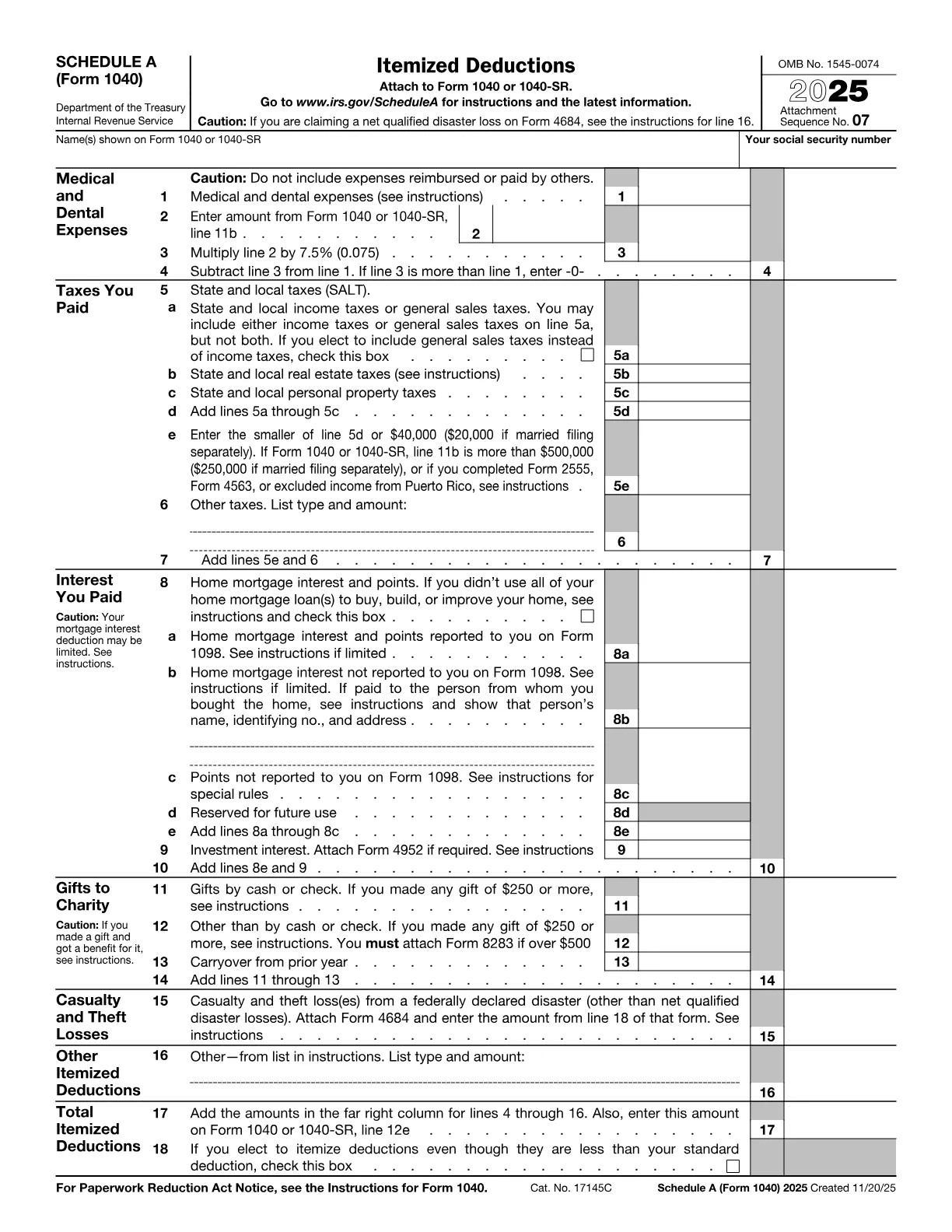
Every line, explained
No line matches that. Try a line number like 8a, or a word like medical.
Medical and dental expenses
1Medical and dental expenses
Medical and dental costs the taxpayer paid in 2025 for themselves, a spouse and dependents, after any insurance or other reimbursement: doctors, dentists, hospitals, prescriptions, glasses, hearing aids, health insurance premiums paid with after-tax money (including Medicare Part B and D), and driving to care at 21 cents a mile plus parking and tolls. Premiums paid pre-tax through an employer plan, and premiums already taken as the self-employed health insurance deduction, are left out. Long-term care premiums count only up to an age-based limit.
Where it comes from: Receipts, pharmacy and provider statements, insurance explanations of benefits, and Form SSA-1099 for Medicare premiums withheld.
Practice returns that fill in this line (1):
2Enter amount from Form 1040 or 1040-SR, line 11b
Adjusted gross income, carried here because the medical deduction is measured against it.
Where it comes from: Form 1040, line 11b.
Practice returns that fill in this line (1):
3Multiply line 2 by 7.5% (0.075)
The floor: only medical expenses above 7.5% of AGI are deductible. For many taxpayers this wipes out the medical deduction entirely.
Where it comes from: Line 2.
Practice returns that fill in this line (1):
4Subtract line 3 from line 1
The deductible medical and dental expenses, never below zero.
Where it comes from: Line 1 minus line 3.
Practice returns: none use this line yet. Request one.
Taxes you paid
5aState and local income taxes or general sales taxes
Either state and local income taxes or general sales taxes, not both. Income taxes are what was withheld during 2025, estimated payments made in 2025 (including a prior-year refund applied to 2025), and balances paid in 2025 for earlier years, without penalties or interest. Choosing sales tax means checking the box and using actual receipts or the optional sales tax tables in the instructions, plus sales tax on specified items such as a car; it usually wins in a state with no income tax.
Where it comes from: Form W-2 state and local tax boxes, 1099s, state estimated payment records and prior-year state returns, or the Sales Tax Deduction Worksheet.
Practice returns that fill in this line (3):
5bState and local real estate taxes
Property taxes on real estate the taxpayer owns and does not use for business, if assessed uniformly on all property in the community. Leave out charges for specific services (trash, water) and assessments for improvements like a new sidewalk. With an escrow account, deduct what the lender actually paid to the taxing authority in 2025; a prepayment counts only if the tax was assessed before 2026.
Where it comes from: The real estate tax bill, the escrow section of Form 1098 or the lender's year-end statement, and the settlement statement for a purchase or sale.
Practice returns that fill in this line (3):
5cState and local personal property taxes
Taxes based on the value of personal property and charged every year. The common one is the value-based part of a car registration fee; a part based on weight or a flat fee is not deductible.
Where it comes from: Vehicle registration renewals and personal property tax bills.
Practice returns: none use this line yet. Request one.
5dAdd lines 5a through 5c
Total state and local taxes before the cap.
Where it comes from: Lines 5a to 5c.
Practice returns that fill in this line (3):
5eState and local tax deduction (the SALT cap)New for 2025
The smaller of line 5d or $40,000 ($20,000 married filing separately), up from $10,000 before 2025. If Form 1040 line 11b is more than $500,000 ($250,000 married filing separately), or the taxpayer filed Form 2555 or 4563 or excluded Puerto Rico income, the State and Local Tax Deduction Worksheet lowers the cap by 30% of the excess, but never below $10,000; married filing separately takes half of the worksheet result. Total taxes of $10,000 ($5,000 married filing separately) or less are never limited.
Where it comes from: Line 5d, Form 1040 line 11b, and the worksheet in the Schedule A instructions.
Practice returns that fill in this line (3):
6Other taxes
Foreign income taxes the taxpayer chooses to deduct instead of taking the foreign tax credit, and generation-skipping tax on certain income distributions. List each type and amount. These are outside the SALT cap.
Where it comes from: Form 1099-DIV or 1099-INT foreign tax boxes, K-1s and foreign tax statements.
Practice returns: none use this line yet. Request one.
7Add lines 5e and 6
Total deductible taxes.
Where it comes from: Lines 5e and 6.
Practice returns that fill in this line (3):
Interest you paid
8Home mortgage interest and points: checkbox
Check the box if, during 2025, the taxpayer had a home mortgage and did not use all of the loan to buy, build or substantially improve the home (for example a cash-out refinance or a home equity loan spent on a car). Interest on the part used for anything else is not deductible on lines 8a or 8b, and Pub. 936 figures the deductible share.
Where it comes from: Loan documents and how the proceeds were spent.
8aHome mortgage interest and points reported on Form 1098
Interest and points on loans secured by the main home or a second home. The deduction is limited to interest on $750,000 of debt taken out after December 15, 2017 ($375,000 married filing separately), or $1,000,000 ($500,000) for debt taken out on or before that date; above those amounts, Pub. 936 figures the deductible part. A co-borrower who is not a spouse deducts only their share. A mortgage interest credit from Form 8396 reduces this line.
Where it comes from: Form 1098 box 1 (interest) and box 6 (points).
Practice returns that fill in this line (3):
8bHome mortgage interest not reported on Form 1098
Deductible home mortgage interest with no Form 1098, most often a mortgage held by the seller or another individual. Show the lender's name, address and SSN or EIN on the dotted lines; leaving them off can cost a $50 penalty. Also used for a share of interest reported on someone else's Form 1098.
Where it comes from: The loan agreement and payment records.
Practice returns: none use this line yet. Request one.
8cPoints not reported on Form 1098
Points paid only to borrow money, not shown on a Form 1098. They are generally deducted over the life of the loan, including points on a refinance; points for a lender's services are not deductible. Remaining points are deducted when a loan is paid off early, with an exception for refinancing with the same lender.
Where it comes from: The settlement statement (Closing Disclosure).
Practice returns: none use this line yet. Request one.
8dReserved for future use
Nothing goes on this line for 2025.
Where it comes from: Nothing.
Practice returns: none use this line yet. Request one.
8eAdd lines 8a through 8c
Total deductible home mortgage interest and points.
Where it comes from: Lines 8a to 8c.
Practice returns that fill in this line (3):
9Investment interest
Interest on money borrowed to buy investment property, such as a margin loan, limited to net investment income. Form 4952 figures it and is attached unless the expense is less than interest and ordinary dividends minus qualified dividends, there are no other deductible investment expenses, and nothing was disallowed from 2024. Interest tied to passive activities or tax-exempt securities does not belong here.
Where it comes from: Brokerage statements and Form 4952.
Practice returns: none use this line yet. Request one.
10Add lines 8e and 9
Total deductible interest.
Where it comes from: Lines 8e and 9.
Practice returns that fill in this line (3):
Gifts to charity
11Gifts by cash or check
Money given to qualified charities, including out-of-pocket costs of volunteering (driving at 14 cents a mile plus parking and tolls). Every cash gift needs a bank record or written record from the charity, and a single gift of $250 or more needs a written acknowledgment from the charity, received by the time the return is filed. If the taxpayer got something back, such as a dinner, only the amount above its value counts. If cash gifts are more than 30% of AGI, Pub. 526 figures whether a limit applies.
Where it comes from: Bank and card statements and charity acknowledgment letters.
Practice returns that fill in this line (3):
12Other than by cash or check
Donated property such as clothing, furniture, a car or stock, generally at fair market value. Used clothing and household items must be in good used condition or better. If the total for property is over $500, Form 8283 must be attached; larger gifts may need a qualified appraisal.
Where it comes from: Donation receipts, the taxpayer's valuation records, Form 1098-C for a vehicle, and Form 8283.
Practice returns that fill in this line (1):
13Carryover from prior year
Contributions from earlier years that could not be deducted because they exceeded the AGI limits. They can generally be carried forward for 5 years, under the same limits that applied in the year of the gift.
Where it comes from: The prior year's return and carryover worksheet.
Practice returns: none use this line yet. Request one.
14Add lines 11 through 13
Total charitable deduction.
Where it comes from: Lines 11 to 13.
Practice returns that fill in this line (3):
Casualty and theft losses, and other deductions
15Casualty and theft loss(es) from a federally declared disaster
Personal casualty and theft losses are deductible only when caused by a federally declared disaster, and only the part of each loss over $100 and of the total over 10% of AGI. Form 4684 figures it; enter its line 18. A net qualified disaster loss goes on line 16 instead.
Where it comes from: Form 4684, insurance claim records and the disaster declaration.
Practice returns: none use this line yet. Request one.
16Other itemized deductions
Only the items on the list in the instructions, each named with its amount: gambling losses up to the gambling winnings reported on Schedule 1, casualty and theft losses of income-producing property, federal estate tax on income in respect of a decedent, a repayment of over $3,000 under a claim of right, certain unrecovered investment in a pension, impairment-related work expenses of a disabled person, and a net qualified disaster loss, among others. Unreimbursed employee expenses and tax preparation fees are not on the list.
Where it comes from: Form W-2G and gambling records, Form 4684, and the documents for each item.
Practice returns: none use this line yet. Request one.
Total itemized deductions
17Total itemized deductions
The far right column of lines 4 through 16 added up, carried to Form 1040, line 12e. Itemizing helps only when this beats the standard deduction, which for 2025 is $15,750 single, $31,500 married filing jointly and $23,625 head of household, before the extra amounts for age and blindness.
Where it comes from: Lines 4, 7, 10, 14, 15 and 16.
Practice returns that fill in this line (3):
18Election to itemize even though less than the standard deduction
Check the box to itemize even though the total is less than the standard deduction, usually for state tax purposes, when the state return follows the federal choice and itemizing saves more state tax.
Where it comes from: A comparison of the federal and state returns both ways.
Practice returns that fill in this line (1):
Practice it on a full return
Schedule A only matters once you know whether it beats the standard deduction, and that depends on the rest of the return. Every practice return gives you a taxpayer, their documents and an answer key, so you can build the itemized deductions from a Form 1098, a property tax bill and charity receipts and see where line 17 lands on Form 1040, line 12e.
FAQ
What is the SALT deduction limit for 2025?
$40,000, or $20,000 if married filing separately, up from $10,000. If Form 1040 line 11b is more than $500,000 ($250,000 married filing separately), a worksheet in the Schedule A instructions reduces the limit, but not below $10,000 ($5,000 married filing separately). The limit applies to lines 5a through 5c together and is entered on line 5e.
Should I itemize or take the standard deduction?
Itemize when Schedule A, line 17 is more than your standard deduction: for 2025, $15,750 single, $31,500 married filing jointly and $23,625 head of household, plus the extra amounts for age or blindness. You can still elect to itemize when the total is smaller, usually for state tax reasons, by checking the box on line 18.
How much of my medical expenses can I deduct?
Only the part above 7.5% of your adjusted gross income. Total the unreimbursed medical and dental expenses on line 1, and Schedule A subtracts 7.5% of AGI on line 3; what is left on line 4 is the deduction.
Can I take the new tips, overtime and senior deductions if I itemize?
Yes. The deductions for qualified tips, qualified overtime, car loan interest and seniors are claimed on Schedule 1-A, not Schedule A, and are allowed whether you itemize or take the standard deduction.