Schedule B lists who paid a taxpayer interest and ordinary dividends, and asks about foreign accounts and foreign trusts. It is required when taxable interest or ordinary dividends are over $1,500, and in a few other cases such as seller-financed mortgage interest, savings bond interest excluded for education, or a foreign financial account.
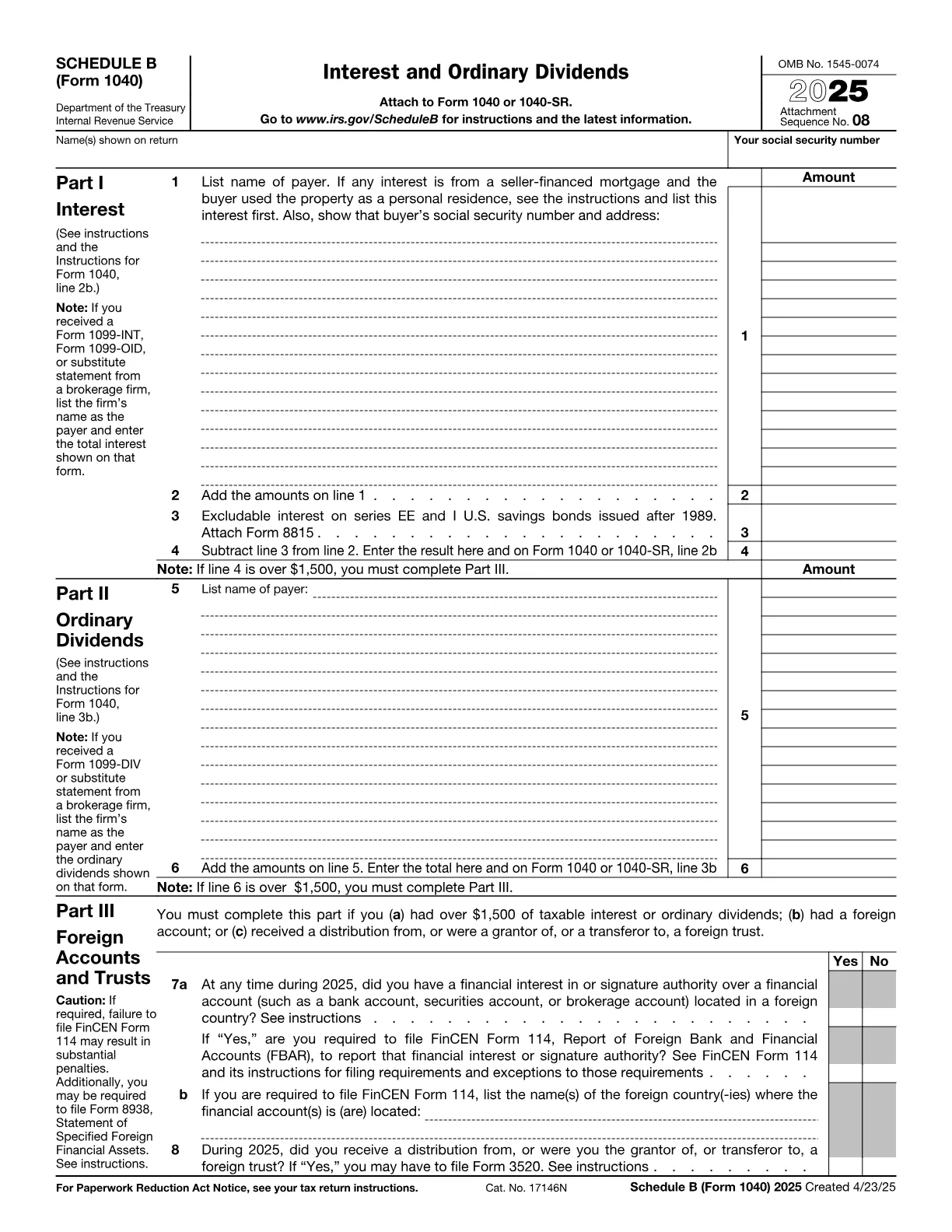
Every line, explained
No line matches that. Try a line number like 4, or a word like brokerage.
Part I: Interest
1List name of payer and amount
Every payer of taxable interest, one per entry, with the amount: banks, credit unions, Treasury bonds, savings bonds and brokerage accounts. For a brokerage, list the firm as the payer with the total from its statement. Interest from a seller-financed mortgage on a home the buyer lives in goes first, with the buyer's name, address and SSN (leaving them off can cost a $50 penalty). Tax-exempt interest is not listed here; it goes on Form 1040, line 2a.
Where it comes from: Form 1099-INT (box 1, plus box 3 for savings bond and Treasury interest), Form 1099-OID, brokerage statements, and the note for a seller-financed mortgage.
Practice returns that fill in this line (7):
- District of Columbia investor: DC's own standard deduction and the out-of-state muni bond addback
- Illinois retirees: retirement income subtraction and property tax credit
- Investor with dividends and stock sales
- Kentucky investor: Treasury interest subtraction and Louisville occupational tax
- Kiddie tax: a teenager's interest taxed at her parents' rate
- Seller-financed land sale on Form 6252
- Six K-1s, a partnership exit, and Section 1231
2Add the amounts on line 1
Total interest listed. If any of it was received as a nominee (it belongs to someone else), or needs an adjustment for accrued interest paid when buying a bond, original issue discount or amortizable bond premium, the instructions say to subtotal line 1, list the amount to subtract with its label (for example "Nominee Distribution" or "Accrued Interest"), and enter the net figure here.
Where it comes from: Line 1.
Practice returns that fill in this line (7):
- District of Columbia investor: DC's own standard deduction and the out-of-state muni bond addback
- Illinois retirees: retirement income subtraction and property tax credit
- Investor with dividends and stock sales
- Kentucky investor: Treasury interest subtraction and Louisville occupational tax
- Kiddie tax: a teenager's interest taxed at her parents' rate
- Seller-financed land sale on Form 6252
- Six K-1s, a partnership exit, and Section 1231
3Excludable interest on series EE and I U.S. savings bonds issued after 1989
Interest from cashing series EE or I savings bonds issued after 1989 can be excluded, in part or in full, when the taxpayer paid qualified higher education expenses for themselves, a spouse or a dependent in the same year. Form 8815 figures the excludable amount and is attached.
Where it comes from: Form 8815, with Form 1099-INT box 3 and the education expense records.
Practice returns: none use this line yet. Request one.
4Subtract line 3 from line 2
Taxable interest. It goes on Form 1040, line 2b. If it is over $1,500, Part III must be completed.
Where it comes from: Line 2 minus line 3.
Practice returns that fill in this line (7):
- District of Columbia investor: DC's own standard deduction and the out-of-state muni bond addback
- Illinois retirees: retirement income subtraction and property tax credit
- Investor with dividends and stock sales
- Kentucky investor: Treasury interest subtraction and Louisville occupational tax
- Kiddie tax: a teenager's interest taxed at her parents' rate
- Seller-financed land sale on Form 6252
- Six K-1s, a partnership exit, and Section 1231
Part II: Ordinary dividends
5List name of payer and amount
Every payer of ordinary dividends with the amount, a brokerage listed once with the total from its statement. Ordinary dividends already include any qualified dividends, so the full box 1a amount goes here. Dividends received as a nominee are listed, subtotaled, and then subtracted under the label "Nominee Distribution".
Where it comes from: Form 1099-DIV box 1a, or the brokerage's substitute statement.
Practice returns that fill in this line (6):
- District of Columbia investor: DC's own standard deduction and the out-of-state muni bond addback
- Foreign dividends and the foreign tax credit
- Investor with dividends and stock sales
- Kentucky investor: Treasury interest subtraction and Louisville occupational tax
- North Dakota: the 40% exclusion for capital gains and qualified dividends
- Wages, a rental, and a brokerage account
6Add the amounts on line 5
Total ordinary dividends. It goes on Form 1040, line 3b. If it is over $1,500, Part III must be completed.
Where it comes from: Line 5.
Practice returns that fill in this line (6):
- District of Columbia investor: DC's own standard deduction and the out-of-state muni bond addback
- Foreign dividends and the foreign tax credit
- Investor with dividends and stock sales
- Kentucky investor: Treasury interest subtraction and Louisville occupational tax
- North Dakota: the 40% exclusion for capital gains and qualified dividends
- Wages, a rental, and a brokerage account
Part III: Foreign accounts and trusts
Part IIIWho must complete Part III
Anyone with over $1,500 of taxable interest or ordinary dividends, anyone with a foreign financial account, and anyone who received a distribution from, or was a grantor of or transferor to, a foreign trust. Most returns that reach Part III answer no to every question, but the questions still have to be answered.
Where it comes from: Lines 4 and 6, and the taxpayer.
7aFinancial interest in or signature authority over a foreign financial account
Two questions. First: at any time in 2025, did the taxpayer have a financial interest in, or signature authority over, an account located outside the United States? Check yes even if no FBAR is required. Second: is the taxpayer required to file FinCEN Form 114 (the FBAR)? It is required when the foreign accounts together were worth more than $10,000 at any time during 2025; it is filed electronically with FinCEN, not attached to the return.
Where it comes from: The taxpayer, foreign bank and brokerage statements, and the FinCEN Form 114 instructions.
Practice returns that fill in this line (10):
- District of Columbia investor: DC's own standard deduction and the out-of-state muni bond addback
- Foreign dividends and the foreign tax credit
- Illinois retirees: retirement income subtraction and property tax credit
- Investor with dividends and stock sales
- Kentucky investor: Treasury interest subtraction and Louisville occupational tax
- Kiddie tax: a teenager's interest taxed at her parents' rate
- North Dakota: the 40% exclusion for capital gains and qualified dividends
- Seller-financed land sale on Form 6252
- Six K-1s, a partnership exit, and Section 1231
- Wages, a rental, and a brokerage account
7bName of foreign country
If an FBAR is required, the name of each country where the foreign accounts are located. A separate statement can be attached if there is not enough room.
Where it comes from: The foreign account statements.
Practice returns: none use this line yet. Request one.
8Distribution from, or grantor of or transferor to, a foreign trust
Yes if, during 2025, the taxpayer received a distribution from a foreign trust (a loan of cash or marketable securities generally counts) or was its grantor or a transferor to it. A yes may mean filing Form 3520, which is filed separately, not attached to Form 1040. An owner of a foreign grantor trust must also make sure the trust files Form 3520-A.
Where it comes from: The taxpayer and any foreign trust documents.
Practice returns that fill in this line (10):
- District of Columbia investor: DC's own standard deduction and the out-of-state muni bond addback
- Foreign dividends and the foreign tax credit
- Illinois retirees: retirement income subtraction and property tax credit
- Investor with dividends and stock sales
- Kentucky investor: Treasury interest subtraction and Louisville occupational tax
- Kiddie tax: a teenager's interest taxed at her parents' rate
- North Dakota: the 40% exclusion for capital gains and qualified dividends
- Seller-financed land sale on Form 6252
- Six K-1s, a partnership exit, and Section 1231
- Wages, a rental, and a brokerage account
Practice it on a full return
Schedule B is mostly copying, and the work is in reading the documents: which box of the 1099-INT is taxable, what goes to line 2a instead, and how ordinary and qualified dividends split. Every practice return gives you a taxpayer, their 1099s and an answer key, so you can fill in Schedule B and carry lines 4 and 6 to Form 1040, lines 2b and 3b.
FAQ
When do I have to file Schedule B?
When taxable interest or ordinary dividends are over $1,500. It is also required, at any amount, for interest from a seller-financed mortgage on a home the buyer lives in, for excluding savings bond interest used for education, for nominee income or adjustments to the amounts on a 1099, and when you had a foreign financial account or dealings with a foreign trust.
Do I list every account at my brokerage separately?
No. If you received a Form 1099-INT, 1099-OID, 1099-DIV or a combined substitute statement from a brokerage firm, list the firm's name as the payer and enter the total shown on that form.
Does tax-exempt interest go on Schedule B?
No. Tax-exempt interest, such as municipal bond interest and exempt-interest dividends, goes on Form 1040, line 2a. Schedule B lists only taxable interest.
What is the foreign account question on Schedule B?
Line 7a asks whether you had a financial interest in, or signature authority over, a financial account located in a foreign country at any time during 2025, and whether you must file FinCEN Form 114 (the FBAR). The FBAR is required when the foreign accounts together were worth more than $10,000 at any time during the year, and it is filed electronically with FinCEN, not with the tax return.