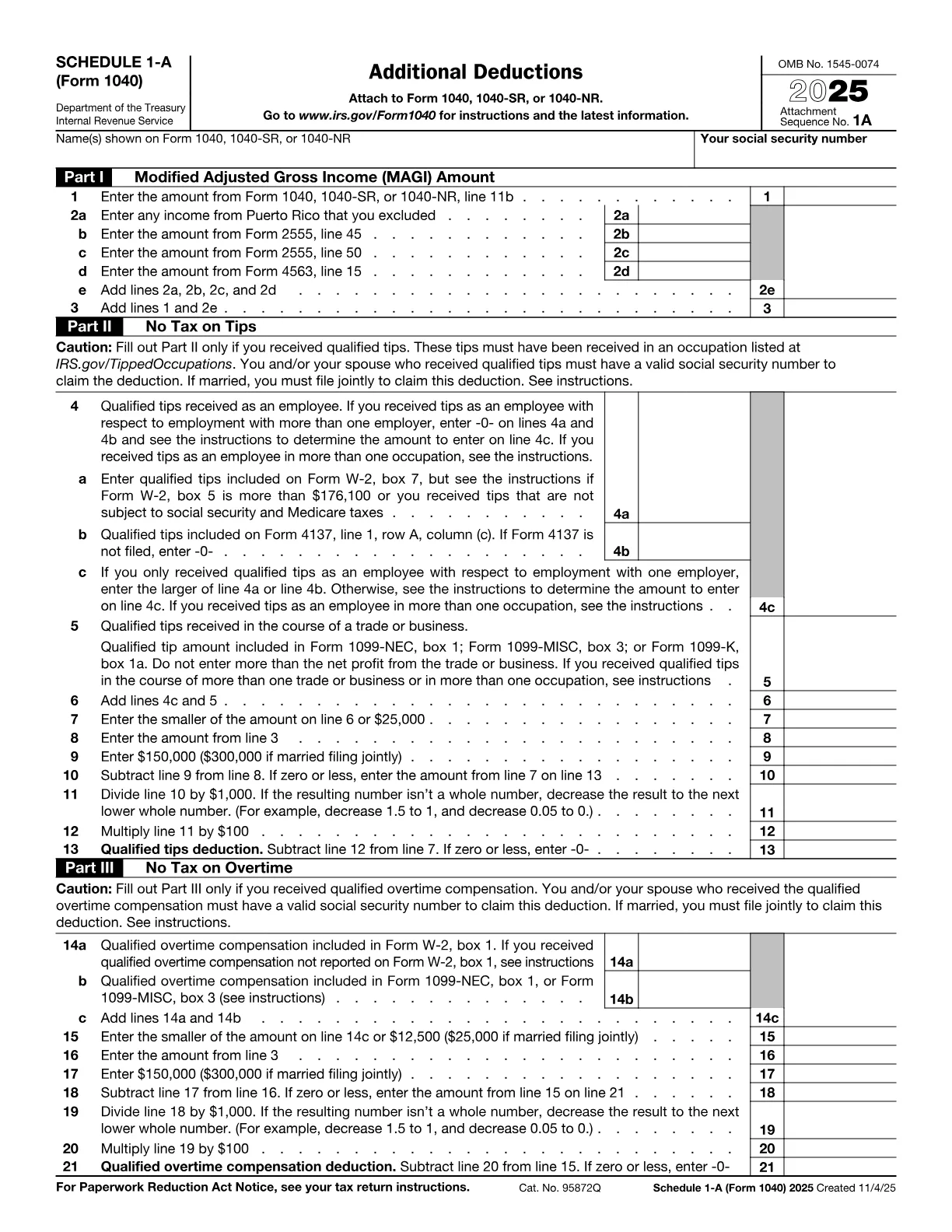
Schedule 1-A is new for 2025. It figures the four deductions added by the One Big Beautiful Bill Act: qualified tips, qualified overtime, interest on a loan for a new US-assembled vehicle, and the enhanced deduction for seniors. The total goes on Form 1040 line 13b, and it can be claimed whether the taxpayer takes the standard deduction or itemizes.
Every line, explained
No line matches that. Try a line number like 36a, or a word like overtime.
Part I: Modified adjusted gross income (MAGI)
1Enter the amount from Form 1040, 1040-SR, or 1040-NR, line 11bNew for 2025
Start with adjusted gross income from page 2 of Form 1040.
Where it comes from: Form 1040 line 11b.
Practice returns that fill in this line (15):
- Arkansas: the $6,000 retirement income exemption
- Illinois retirees: retirement income subtraction and property tax credit
- Louisiana retiree: the $12,000 retirement exemption and the new 3% flat tax
- Nebraska retirees: Social Security fully exempt
- No Tax on Car Loan Interest, phased out: the round-up rule
- No Tax on Car Loan Interest: a new US-assembled car bought in 2025
- No Tax on Overtime, phased out: a Wyoming lineworker over the threshold
- No Tax on Overtime: a warehouse worker deducts the overtime premium
- No Tax on Tips, phased out: a high-earning Las Vegas bartender
- No Tax on Tips: a restaurant server claims the new 2025 tip deduction
- Required minimum distribution with a qualified charitable distribution
- Retiree with Social Security and a pension
- The $6,000 senior deduction: a retiree stacks it on the age-65 standard deduction
- The senior deduction, phased out: a retired couple both over 65
- West Virginia retiree: the 65% Social Security subtraction and the senior deduction it uses up
2a to 2eExcluded Puerto Rico income, Form 2555 lines 45 and 50, Form 4563 line 15New for 2025
Income excluded from AGI is added back: Puerto Rico income the taxpayer excluded (2a), the amounts from Form 2555 lines 45 and 50 (2b and 2c), which carry the foreign earned income and housing exclusion and the housing deduction, and the American Samoa exclusion from Form 4563 (2d). Line 2e totals them. Most taxpayers leave these lines blank.
Where it comes from: Forms 2555 and 4563, and the taxpayer's Puerto Rico income records.
Practice returns: none use this line yet. Request one.
3Add lines 1 and 2eNew for 2025
Modified AGI. Every phase-out on the schedule (tips, overtime, car loan interest and seniors) measures income from this one line, so for most taxpayers it is simply AGI.
Where it comes from: Lines 1 and 2e.
Practice returns that fill in this line (15):
- Arkansas: the $6,000 retirement income exemption
- Illinois retirees: retirement income subtraction and property tax credit
- Louisiana retiree: the $12,000 retirement exemption and the new 3% flat tax
- Nebraska retirees: Social Security fully exempt
- No Tax on Car Loan Interest, phased out: the round-up rule
- No Tax on Car Loan Interest: a new US-assembled car bought in 2025
- No Tax on Overtime, phased out: a Wyoming lineworker over the threshold
- No Tax on Overtime: a warehouse worker deducts the overtime premium
- No Tax on Tips, phased out: a high-earning Las Vegas bartender
- No Tax on Tips: a restaurant server claims the new 2025 tip deduction
- Required minimum distribution with a qualified charitable distribution
- Retiree with Social Security and a pension
- The $6,000 senior deduction: a retiree stacks it on the age-65 standard deduction
- The senior deduction, phased out: a retired couple both over 65
- West Virginia retiree: the 65% Social Security subtraction and the senior deduction it uses up
Part II: No tax on tips
4aQualified tips included on Form W-2, box 7New for 2025
Tips received as an employee in an occupation on the IRS list of occupations that customarily and regularly received tips on or before December 31, 2024 (IRS.gov/TippedOccupations). Box 7 is one way to measure them; the instructions also allow the tips reported to the employer on Form 4070, or an amount the employer shows in box 14, which matters if box 5 is more than $176,100. Service charges and automatic gratuities are not qualified tips. With more than one employer, enter zero and use line 4c.
Where it comes from: Form W-2 boxes 7 and 14, or the taxpayer's Forms 4070.
Practice returns that fill in this line (2):
4bQualified tips included on Form 4137, line 1, row A, column (c)New for 2025
Tips the employee did not report to the employer and is reporting on Form 4137. Enter zero if there is no Form 4137.
Where it comes from: Form 4137.
Practice returns: none use this line yet. Request one.
4cQualified tips received as an employeeNew for 2025
With one employer, the larger of line 4a or line 4b. With more than one employer, the Qualified Tips From More Than One Employer Worksheet in the instructions takes the larger figure for each employer and adds them.
Where it comes from: Lines 4a and 4b, or the worksheet.
Practice returns that fill in this line (2):
5Qualified tips received in the course of a trade or businessNew for 2025
Tips a self-employed person received that are included in Form 1099-NEC box 1, 1099-MISC box 3 or 1099-K box 1a, backed by records such as tip logs or the platform's earnings statement. Cash that never appeared on a 1099 does not count. The amount can't be more than the business's net income after its share of the self-employment tax deduction, retirement contributions and health insurance. Tips from a specified service trade or business do not qualify.
Where it comes from: Forms 1099, the platform's earnings statement, Schedule C, and the Multiple Trades or Businesses Worksheet.
Practice returns: none use this line yet. Request one.
6Add lines 4c and 5New for 2025
Total qualified tips, employee and self-employed.
Where it comes from: Lines 4c and 5.
Practice returns that fill in this line (2):
7Enter the smaller of the amount on line 6 or $25,000New for 2025
The deduction is capped at $25,000 of qualified tips for every filing status. On a joint return the cap covers both spouses together; it is not per spouse.
Where it comes from: Line 6.
Practice returns that fill in this line (2):
8 to 12Tips phase-outNew for 2025
The deduction shrinks once modified AGI (line 3) passes $150,000 ($300,000 married filing jointly). Line 11 counts each full $1,000 over (rounding down), and line 12 takes away $100 for each one. If line 10 is zero or less, skip lines 11 and 12; there is no reduction.
Where it comes from: Line 3.
Practice returns that fill in this line (2):
13Qualified tips deductionNew for 2025
Line 7 minus line 12, never below zero. The person who received the tips needs a valid SSN (valid for employment and issued before the return's due date, including extensions), and a married taxpayer must file jointly.
Where it comes from: Lines 7 and 12.
Practice returns that fill in this line (2):
Part III: No tax on overtime
14aQualified overtime compensation included in Form W-2, box 1New for 2025
Only the overtime premium the Fair Labor Standards Act requires: the "half" of time-and-a-half, paid to an FLSA-eligible (nonexempt) employee. If a pay stub shows total pay for overtime hours at time-and-a-half, divide it by 3. Extra pay beyond time-and-a-half, holiday or weekend premiums without more than 40 hours, and overtime owed only under state law do not count. Some employers show the amount in box 14.
Where it comes from: Form W-2 box 14, final pay stubs, or the employer's overtime records.
Practice returns that fill in this line (2):
14bQualified overtime compensation included in Form 1099-NEC, box 1, or Form 1099-MISC, box 3New for 2025
The qualified overtime part of pay reported on a 1099-NEC or 1099-MISC, never the whole box.
Where it comes from: The payer's statement of overtime.
Practice returns: none use this line yet. Request one.
14cAdd lines 14a and 14bNew for 2025
Total qualified overtime compensation.
Where it comes from: Lines 14a and 14b.
Practice returns that fill in this line (2):
15Enter the smaller of line 14c or $12,500 ($25,000 if married filing jointly)New for 2025
The cap is $12,500, or $25,000 on a joint return. The joint limit is for both spouses combined, not per spouse.
Where it comes from: Line 14c.
Practice returns that fill in this line (2):
16 to 20Overtime phase-outNew for 2025
Same shape as the tips phase-out: modified AGI over $150,000 ($300,000 married filing jointly) costs $100 for each full $1,000 over, rounding down on line 19. If line 18 is zero or less, skip lines 19 and 20.
Where it comes from: Line 3.
Practice returns that fill in this line (2):
21Qualified overtime compensation deductionNew for 2025
Line 15 minus line 20, never below zero. The person who earned the overtime needs a valid SSN, and a married taxpayer must file jointly.
Where it comes from: Lines 15 and 20.
Practice returns that fill in this line (2):
Part IV: No tax on car loan interest
22Applicable passenger vehicle: VIN, interest deducted on Schedule C, E or F, and interest for Schedule 1-ANew for 2025
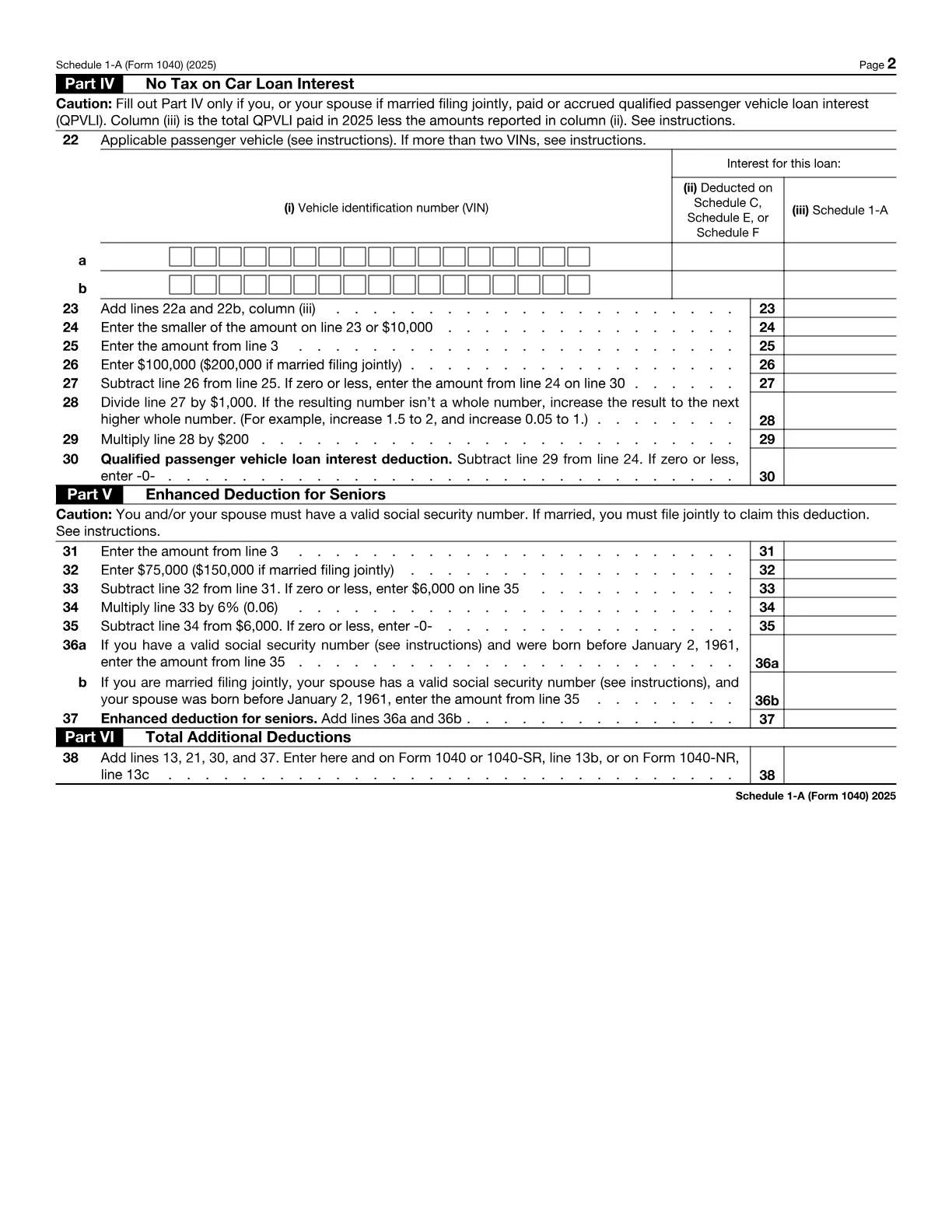
One row per vehicle: the VIN (required), interest already deducted on Schedule C, E or F in column (ii), and the rest of the year's interest in column (iii). The loan must be taken out after December 31, 2024, to buy a new vehicle (a lease or used vehicle does not qualify) with final assembly in the United States: a car, minivan, van, SUV, pickup or motorcycle under 14,000 pounds gross vehicle weight, bought mainly for personal use and secured by a first lien. More than two VINs go on an attached statement.
Where it comes from: The lender's year-end interest statement, the purchase contract, and the vehicle label or VIN decoder for the assembly plant.
Practice returns that fill in this line (2):
23Add lines 22a and 22b, column (iii)New for 2025
Total qualified passenger vehicle loan interest for Schedule 1-A.
Where it comes from: Line 22, column (iii).
Practice returns that fill in this line (2):
24Enter the smaller of the amount on line 23 or $10,000New for 2025
The deduction is capped at $10,000 of interest a year.
Where it comes from: Line 23.
Practice returns that fill in this line (2):
25 to 29Car loan interest phase-outNew for 2025
Modified AGI over $100,000 ($200,000 married filing jointly) reduces the deduction by $200 for each $1,000 over. Unlike the tips and overtime phase-outs, line 28 rounds up, so any part of $1,000 counts. If line 27 is zero or less, skip lines 28 and 29.
Where it comes from: Line 3.
Practice returns that fill in this line (2):
30Qualified passenger vehicle loan interest deductionNew for 2025
Line 24 minus line 29, never below zero. Interest deducted on Schedule C, E or F can't be deducted again here.
Where it comes from: Lines 24 and 29.
Practice returns that fill in this line (2):
Part V: Enhanced deduction for seniors
31 to 34Seniors phase-outNew for 2025
Modified AGI over $75,000 ($150,000 married filing jointly) is multiplied by 6% on line 34. If line 33 is zero or less, the full $6,000 goes on line 35.
Where it comes from: Line 3.
Practice returns that fill in this line (9):
- Arkansas: the $6,000 retirement income exemption
- Illinois retirees: retirement income subtraction and property tax credit
- Louisiana retiree: the $12,000 retirement exemption and the new 3% flat tax
- Nebraska retirees: Social Security fully exempt
- Required minimum distribution with a qualified charitable distribution
- Retiree with Social Security and a pension
- The $6,000 senior deduction: a retiree stacks it on the age-65 standard deduction
- The senior deduction, phased out: a retired couple both over 65
- West Virginia retiree: the 65% Social Security subtraction and the senior deduction it uses up
35Subtract line 34 from $6,000New for 2025
The deduction for each eligible person after the phase-out, never below zero.
Where it comes from: Line 34.
Practice returns that fill in this line (9):
- Arkansas: the $6,000 retirement income exemption
- Illinois retirees: retirement income subtraction and property tax credit
- Louisiana retiree: the $12,000 retirement exemption and the new 3% flat tax
- Nebraska retirees: Social Security fully exempt
- Required minimum distribution with a qualified charitable distribution
- Retiree with Social Security and a pension
- The $6,000 senior deduction: a retiree stacks it on the age-65 standard deduction
- The senior deduction, phased out: a retired couple both over 65
- West Virginia retiree: the 65% Social Security subtraction and the senior deduction it uses up
36aYou: valid SSN and born before January 2, 1961New for 2025
The amount from line 35 if the taxpayer has a valid SSN and was born before January 2, 1961. A taxpayer who died in 2025 before reaching 65 does not qualify.
Where it comes from: Date of birth and SSN card.
Practice returns that fill in this line (9):
- Arkansas: the $6,000 retirement income exemption
- Illinois retirees: retirement income subtraction and property tax credit
- Louisiana retiree: the $12,000 retirement exemption and the new 3% flat tax
- Nebraska retirees: Social Security fully exempt
- Required minimum distribution with a qualified charitable distribution
- Retiree with Social Security and a pension
- The $6,000 senior deduction: a retiree stacks it on the age-65 standard deduction
- The senior deduction, phased out: a retired couple both over 65
- West Virginia retiree: the 65% Social Security subtraction and the senior deduction it uses up
36bSpouse: married filing jointly, valid SSN, and born before January 2, 1961New for 2025
The same amount again for a spouse on a joint return who also qualifies.
Where it comes from: The spouse's date of birth and SSN card.
Practice returns that fill in this line (4):
37Enhanced deduction for seniorsNew for 2025
Lines 36a and 36b added: up to $6,000 per person, $12,000 when both spouses qualify. A married taxpayer must file jointly. It is allowed whether or not the taxpayer itemizes.
Where it comes from: Lines 36a and 36b.
Practice returns that fill in this line (9):
- Arkansas: the $6,000 retirement income exemption
- Illinois retirees: retirement income subtraction and property tax credit
- Louisiana retiree: the $12,000 retirement exemption and the new 3% flat tax
- Nebraska retirees: Social Security fully exempt
- Required minimum distribution with a qualified charitable distribution
- Retiree with Social Security and a pension
- The $6,000 senior deduction: a retiree stacks it on the age-65 standard deduction
- The senior deduction, phased out: a retired couple both over 65
- West Virginia retiree: the 65% Social Security subtraction and the senior deduction it uses up
Part VI: Total additional deductions
38Add lines 13, 21, 30, and 37New for 2025
The four deductions together, carried to Form 1040 line 13b (Form 1040-NR line 13c). They reduce taxable income, not AGI, and are taken with either the standard deduction or itemized deductions.
Where it comes from: Lines 13, 21, 30 and 37.
Practice returns that fill in this line (15):
- Arkansas: the $6,000 retirement income exemption
- Illinois retirees: retirement income subtraction and property tax credit
- Louisiana retiree: the $12,000 retirement exemption and the new 3% flat tax
- Nebraska retirees: Social Security fully exempt
- No Tax on Car Loan Interest, phased out: the round-up rule
- No Tax on Car Loan Interest: a new US-assembled car bought in 2025
- No Tax on Overtime, phased out: a Wyoming lineworker over the threshold
- No Tax on Overtime: a warehouse worker deducts the overtime premium
- No Tax on Tips, phased out: a high-earning Las Vegas bartender
- No Tax on Tips: a restaurant server claims the new 2025 tip deduction
- Required minimum distribution with a qualified charitable distribution
- Retiree with Social Security and a pension
- The $6,000 senior deduction: a retiree stacks it on the age-65 standard deduction
- The senior deduction, phased out: a retired couple both over 65
- West Virginia retiree: the 65% Social Security subtraction and the senior deduction it uses up
Practice it on a full return
The arithmetic on Schedule 1-A is short; the work is deciding what qualifies, like pulling the overtime premium out of a pay stub or checking a VIN and a loan date, and getting modified AGI right for the phase-outs. Every practice return gives you a taxpayer, their documents and an answer key, and the OBBBA practice returns are built around each of the four deductions, including cases where the phase-out cuts them down. Line 38 carries to Form 1040, line 13b.
FAQ
Do I have to itemize to deduct tips or overtime?
No. The Schedule 1-A deductions go on Form 1040 line 13b, separate from the standard deduction or Schedule A, so you can take them either way. A married taxpayer must file a joint return to claim the tips, overtime or senior deduction, and the person who received the tips or overtime, or who claims the senior deduction, needs a valid social security number.
How do I figure qualified overtime if my W-2 doesn't show it?
Only the "half" of time-and-a-half required by the Fair Labor Standards Act counts. If your pay stub or payroll records show your total pay for overtime hours at time-and-a-half, divide that amount by 3. Some employers show the amount in box 14 of Form W-2, and you can also ask your employer for your FLSA overtime premium. The deduction is capped at $12,500, or $25,000 on a joint return.
Which car loans qualify for the interest deduction?
A loan taken out after December 31, 2024, to buy a new car, minivan, van, SUV, pickup or motorcycle under 14,000 pounds that had its final assembly in the United States, bought mainly for personal use and secured by a first lien on the vehicle. Leases and used vehicles don't qualify. You must enter the VIN, the deduction is capped at $10,000 of interest, and it phases out above $100,000 of modified AGI ($200,000 married filing jointly).
Who gets the $6,000 senior deduction?
Each taxpayer born before January 2, 1961, with a valid social security number: up to $6,000 per person, or $12,000 when both spouses on a joint return qualify. It is reduced by 6% of modified AGI over $75,000 ($150,000 married filing jointly).