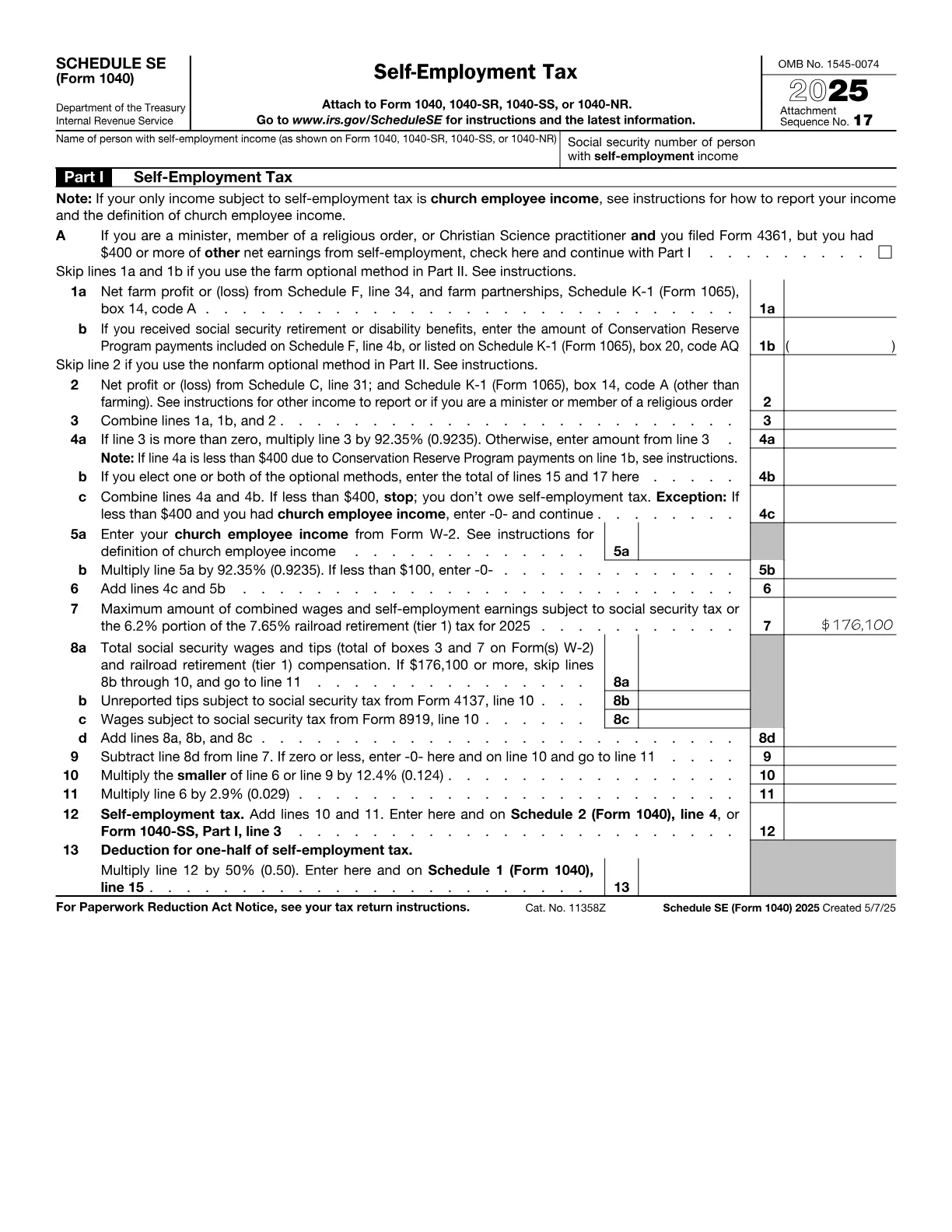
Schedule SE figures the Social Security and Medicare tax that self-employed people pay on their own earnings, and anyone with $400 or more of net earnings from self-employment (or $108.28 or more of church employee income) files it. Tap any line on the form to see what goes there, where the number comes from, and the practice returns that fill it in.
Every line, explained
No line matches that. Try a line number like 8a, or a word like church.
Part I: Self-employment tax
AMinister with an approved Form 4361 and other self-employment income
Check this box for a minister, member of a religious order or Christian Science practitioner whose Form 4361 exemption was approved but who also had $400 or more of other net earnings from self-employment. The exempt ministerial earnings stay off the schedule; the other earnings are taxed.
Where it comes from: The approved Form 4361 and the taxpayer's other business records.
Practice returns: none use this line yet. Request one.
1aNet farm profit or (loss)
Net profit or loss from Schedule F, plus farm partnership earnings. Skip this line if using the farm optional method in Part II.
Where it comes from: Schedule F, line 34, and Schedule K-1 (Form 1065), box 14, code A.
Practice returns that fill in this line (1):
1bConservation Reserve Program payments
For someone receiving Social Security retirement or disability benefits when the payments came in, Conservation Reserve Program payments are not subject to self-employment tax, so they are entered here in parentheses and subtracted.
Where it comes from: Schedule F, line 4b, or Schedule K-1 (Form 1065), box 20, code AQ.
Practice returns: none use this line yet. Request one.
2Net profit or (loss) from Schedule C and nonfarm partnerships
Net profit or loss from every Schedule C, plus nonfarm partnership earnings. A minister adds a housing allowance or the rental value of a parsonage here, even though it is excluded from income tax. A statutory employee's Schedule C profit is left out. Skip this line if using the nonfarm optional method.
Where it comes from: Schedule C, line 31, and Schedule K-1 (Form 1065), box 14, code A.
Practice returns that fill in this line (17):
- Business meals: 50%, 100%, or nothing on Schedule C
- Colorado: starting from federal taxable income with a Schedule C
- Consultant with a SEP-IRA
- Content creator with several income streams
- Freelance designer with a home office
- Independent contractor who expected a refund
- Iowa self-employed photographer: flat 3.8% tax and the school district surtax
- Minister with a housing allowance
- Mississippi self-employed painter: Schedule C, commuting miles, SE tax, QBI, and a state that builds its own AGI
- Montana fishing guide: federal taxable income without QBI
- Online seller with inventory
- Oregon: the federal tax subtraction and the 2025 kicker for a freelancer
- Partner with a K-1 and guaranteed payments
- Real estate agent (Schedule C, actual vehicle expenses)
- Rideshare and delivery driver (gig work)
- Six K-1s, a partnership exit, and Section 1231
- Virginia self-employed: Schedule C, estimates, and the $4,000 Virginia529 deduction
3Combine lines 1a, 1b and 2
All self-employment profit and loss on one line: a loss in one business reduces profit from another. Special amounts, such as exempt notary fees or community income taxed to the other spouse, are written on the dotted line beside it and added or subtracted.
Where it comes from: Lines 1a, 1b and 2.
Practice returns that fill in this line (18):
- Business meals: 50%, 100%, or nothing on Schedule C
- Colorado: starting from federal taxable income with a Schedule C
- Consultant with a SEP-IRA
- Content creator with several income streams
- Freelance designer with a home office
- Independent contractor who expected a refund
- Iowa self-employed photographer: flat 3.8% tax and the school district surtax
- Minister with a housing allowance
- Mississippi self-employed painter: Schedule C, commuting miles, SE tax, QBI, and a state that builds its own AGI
- Montana fishing guide: federal taxable income without QBI
- Online seller with inventory
- Oregon: the federal tax subtraction and the 2025 kicker for a freelancer
- Partner with a K-1 and guaranteed payments
- Real estate agent (Schedule C, actual vehicle expenses)
- Rideshare and delivery driver (gig work)
- Six K-1s, a partnership exit, and Section 1231
- Small farm (Schedule F)
- Virginia self-employed: Schedule C, estimates, and the $4,000 Virginia529 deduction
4aMultiply line 3 by 92.35%
Net earnings from self-employment are 92.35% (0.9235) of the profit on line 3, so the tax is not charged on the full profit. If line 3 is zero or a loss, it is copied as is.
Where it comes from: Line 3.
Practice returns that fill in this line (18):
- Business meals: 50%, 100%, or nothing on Schedule C
- Colorado: starting from federal taxable income with a Schedule C
- Consultant with a SEP-IRA
- Content creator with several income streams
- Freelance designer with a home office
- Independent contractor who expected a refund
- Iowa self-employed photographer: flat 3.8% tax and the school district surtax
- Minister with a housing allowance
- Mississippi self-employed painter: Schedule C, commuting miles, SE tax, QBI, and a state that builds its own AGI
- Montana fishing guide: federal taxable income without QBI
- Online seller with inventory
- Oregon: the federal tax subtraction and the 2025 kicker for a freelancer
- Partner with a K-1 and guaranteed payments
- Real estate agent (Schedule C, actual vehicle expenses)
- Rideshare and delivery driver (gig work)
- Six K-1s, a partnership exit, and Section 1231
- Small farm (Schedule F)
- Virginia self-employed: Schedule C, estimates, and the $4,000 Virginia529 deduction
4bOptional methods
The total of lines 15 and 17 if the taxpayer elects one or both optional methods in Part II.
Where it comes from: Part II, lines 15 and 17.
Practice returns: none use this line yet. Request one.
4cCombine lines 4a and 4b
If this is less than $400, stop: no self-employment tax is owed. The exception is church employee income: enter zero and continue.
Where it comes from: Lines 4a and 4b.
Practice returns that fill in this line (18):
- Business meals: 50%, 100%, or nothing on Schedule C
- Colorado: starting from federal taxable income with a Schedule C
- Consultant with a SEP-IRA
- Content creator with several income streams
- Freelance designer with a home office
- Independent contractor who expected a refund
- Iowa self-employed photographer: flat 3.8% tax and the school district surtax
- Minister with a housing allowance
- Mississippi self-employed painter: Schedule C, commuting miles, SE tax, QBI, and a state that builds its own AGI
- Montana fishing guide: federal taxable income without QBI
- Online seller with inventory
- Oregon: the federal tax subtraction and the 2025 kicker for a freelancer
- Partner with a K-1 and guaranteed payments
- Real estate agent (Schedule C, actual vehicle expenses)
- Rideshare and delivery driver (gig work)
- Six K-1s, a partnership exit, and Section 1231
- Small farm (Schedule F)
- Virginia self-employed: Schedule C, estimates, and the $4,000 Virginia529 deduction
5aChurch employee income from Form W-2
Wages from a church or church-controlled organization that elected out of paying employer Social Security and Medicare taxes. Self-employment tax is due on $108.28 or more of it. A minister's pay is not church employee income.
Where it comes from: Form W-2 from the church employer.
Practice returns: none use this line yet. Request one.
5bMultiply line 5a by 92.35%
If the result is less than $100, enter zero.
Where it comes from: Line 5a.
Practice returns: none use this line yet. Request one.
6Add lines 4c and 5b
Total net earnings from self-employment, the amount the tax is figured on. It also counts toward the Additional Medicare Tax thresholds on Form 8959.
Where it comes from: Lines 4c and 5b.
Practice returns that fill in this line (18):
- Business meals: 50%, 100%, or nothing on Schedule C
- Colorado: starting from federal taxable income with a Schedule C
- Consultant with a SEP-IRA
- Content creator with several income streams
- Freelance designer with a home office
- Independent contractor who expected a refund
- Iowa self-employed photographer: flat 3.8% tax and the school district surtax
- Minister with a housing allowance
- Mississippi self-employed painter: Schedule C, commuting miles, SE tax, QBI, and a state that builds its own AGI
- Montana fishing guide: federal taxable income without QBI
- Online seller with inventory
- Oregon: the federal tax subtraction and the 2025 kicker for a freelancer
- Partner with a K-1 and guaranteed payments
- Real estate agent (Schedule C, actual vehicle expenses)
- Rideshare and delivery driver (gig work)
- Six K-1s, a partnership exit, and Section 1231
- Small farm (Schedule F)
- Virginia self-employed: Schedule C, estimates, and the $4,000 Virginia529 deduction
7Maximum amount subject to social security tax for 2025
Preprinted as $176,100 for 2025. Social Security tax applies to wages and self-employment earnings combined only up to this amount; the Medicare part has no limit.
Where it comes from: Printed on the form.
Practice returns: none use this line yet. Request one.
8aTotal social security wages and tips
Social Security wages and tips from every Form W-2, plus tier 1 railroad retirement compensation. Wages use up the $176,100 limit first. If they are $176,100 or more, skip to line 11: only the Medicare part applies. A statutory employee's Social Security wages are included.
Where it comes from: Form W-2, boxes 3 and 7.
Practice returns: none use this line yet. Request one.
8bUnreported tips subject to social security tax
Tips not reported to the employer, which also count toward the Social Security limit.
Where it comes from: Form 4137, line 10.
Practice returns: none use this line yet. Request one.
8cWages subject to social security tax from Form 8919
Wages from an employer that did not withhold Social Security tax, which also count toward the limit.
Where it comes from: Form 8919, line 10.
Practice returns: none use this line yet. Request one.
8dAdd lines 8a, 8b and 8c
Total wages that already count toward the Social Security limit.
Where it comes from: Lines 8a to 8c.
Practice returns: none use this line yet. Request one.
9Subtract line 8d from line 7
The part of the $176,100 limit left for self-employment earnings. If zero or less, enter zero here and on line 10.
Where it comes from: Lines 7 and 8d.
Practice returns that fill in this line (18):
- Business meals: 50%, 100%, or nothing on Schedule C
- Colorado: starting from federal taxable income with a Schedule C
- Consultant with a SEP-IRA
- Content creator with several income streams
- Freelance designer with a home office
- Independent contractor who expected a refund
- Iowa self-employed photographer: flat 3.8% tax and the school district surtax
- Minister with a housing allowance
- Mississippi self-employed painter: Schedule C, commuting miles, SE tax, QBI, and a state that builds its own AGI
- Montana fishing guide: federal taxable income without QBI
- Online seller with inventory
- Oregon: the federal tax subtraction and the 2025 kicker for a freelancer
- Partner with a K-1 and guaranteed payments
- Real estate agent (Schedule C, actual vehicle expenses)
- Rideshare and delivery driver (gig work)
- Six K-1s, a partnership exit, and Section 1231
- Small farm (Schedule F)
- Virginia self-employed: Schedule C, estimates, and the $4,000 Virginia529 deduction
10Multiply the smaller of line 6 or line 9 by 12.4%
The Social Security part of the tax, 12.4% (0.124): both the employee and the employer share, since the self-employed person is both.
Where it comes from: Lines 6 and 9.
Practice returns that fill in this line (18):
- Business meals: 50%, 100%, or nothing on Schedule C
- Colorado: starting from federal taxable income with a Schedule C
- Consultant with a SEP-IRA
- Content creator with several income streams
- Freelance designer with a home office
- Independent contractor who expected a refund
- Iowa self-employed photographer: flat 3.8% tax and the school district surtax
- Minister with a housing allowance
- Mississippi self-employed painter: Schedule C, commuting miles, SE tax, QBI, and a state that builds its own AGI
- Montana fishing guide: federal taxable income without QBI
- Online seller with inventory
- Oregon: the federal tax subtraction and the 2025 kicker for a freelancer
- Partner with a K-1 and guaranteed payments
- Real estate agent (Schedule C, actual vehicle expenses)
- Rideshare and delivery driver (gig work)
- Six K-1s, a partnership exit, and Section 1231
- Small farm (Schedule F)
- Virginia self-employed: Schedule C, estimates, and the $4,000 Virginia529 deduction
11Multiply line 6 by 2.9%
The Medicare part of the tax, 2.9% (0.029), on all net earnings with no limit. Additional Medicare Tax, if any, is figured separately on Form 8959.
Where it comes from: Line 6.
Practice returns that fill in this line (18):
- Business meals: 50%, 100%, or nothing on Schedule C
- Colorado: starting from federal taxable income with a Schedule C
- Consultant with a SEP-IRA
- Content creator with several income streams
- Freelance designer with a home office
- Independent contractor who expected a refund
- Iowa self-employed photographer: flat 3.8% tax and the school district surtax
- Minister with a housing allowance
- Mississippi self-employed painter: Schedule C, commuting miles, SE tax, QBI, and a state that builds its own AGI
- Montana fishing guide: federal taxable income without QBI
- Online seller with inventory
- Oregon: the federal tax subtraction and the 2025 kicker for a freelancer
- Partner with a K-1 and guaranteed payments
- Real estate agent (Schedule C, actual vehicle expenses)
- Rideshare and delivery driver (gig work)
- Six K-1s, a partnership exit, and Section 1231
- Small farm (Schedule F)
- Virginia self-employed: Schedule C, estimates, and the $4,000 Virginia529 deduction
12Self-employment tax
Lines 10 and 11 added together, carried to Schedule 2, line 4. On a joint return where both spouses have self-employment income, each files a separate Schedule SE and the two taxes are combined on Schedule 2.
Where it comes from: Lines 10 and 11.
Practice returns that fill in this line (18):
- Business meals: 50%, 100%, or nothing on Schedule C
- Colorado: starting from federal taxable income with a Schedule C
- Consultant with a SEP-IRA
- Content creator with several income streams
- Freelance designer with a home office
- Independent contractor who expected a refund
- Iowa self-employed photographer: flat 3.8% tax and the school district surtax
- Minister with a housing allowance
- Mississippi self-employed painter: Schedule C, commuting miles, SE tax, QBI, and a state that builds its own AGI
- Montana fishing guide: federal taxable income without QBI
- Online seller with inventory
- Oregon: the federal tax subtraction and the 2025 kicker for a freelancer
- Partner with a K-1 and guaranteed payments
- Real estate agent (Schedule C, actual vehicle expenses)
- Rideshare and delivery driver (gig work)
- Six K-1s, a partnership exit, and Section 1231
- Small farm (Schedule F)
- Virginia self-employed: Schedule C, estimates, and the $4,000 Virginia529 deduction
13Deduction for one-half of self-employment tax
Half of line 12 (50%), deducted on Schedule 1, line 15, as an adjustment to income. It lowers income tax, not the self-employment tax itself.
Where it comes from: Line 12.
Practice returns that fill in this line (18):
- Business meals: 50%, 100%, or nothing on Schedule C
- Colorado: starting from federal taxable income with a Schedule C
- Consultant with a SEP-IRA
- Content creator with several income streams
- Freelance designer with a home office
- Independent contractor who expected a refund
- Iowa self-employed photographer: flat 3.8% tax and the school district surtax
- Minister with a housing allowance
- Mississippi self-employed painter: Schedule C, commuting miles, SE tax, QBI, and a state that builds its own AGI
- Montana fishing guide: federal taxable income without QBI
- Online seller with inventory
- Oregon: the federal tax subtraction and the 2025 kicker for a freelancer
- Partner with a K-1 and guaranteed payments
- Real estate agent (Schedule C, actual vehicle expenses)
- Rideshare and delivery driver (gig work)
- Six K-1s, a partnership exit, and Section 1231
- Small farm (Schedule F)
- Virginia self-employed: Schedule C, estimates, and the $4,000 Virginia529 deduction
Part II: Optional methods to figure net earnings
14Maximum income for optional methods
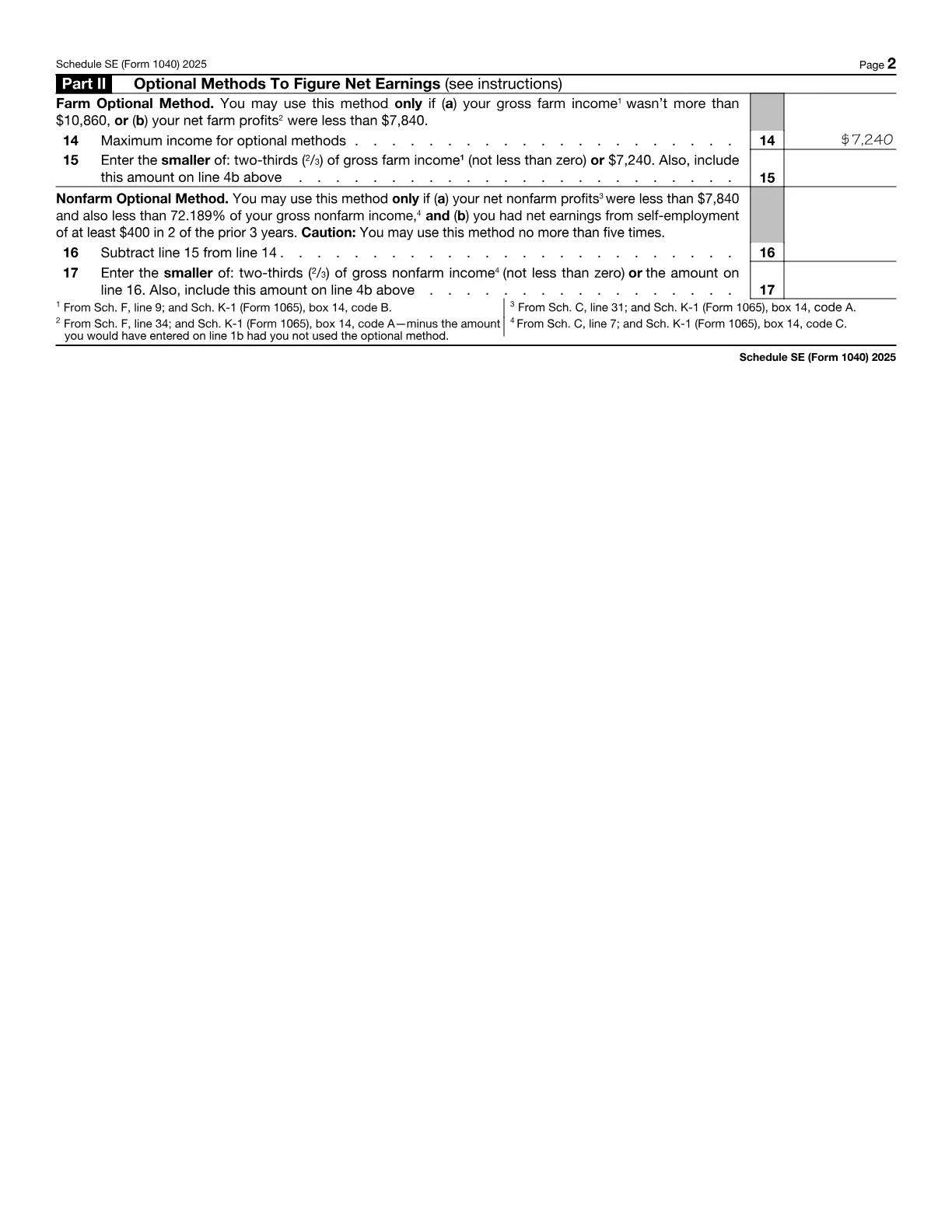
Preprinted as $7,240 for 2025. Neither optional method, nor both together, can report more net earnings than this.
Where it comes from: Printed on the form.
Practice returns: none use this line yet. Request one.
15Farm optional method
Available if gross farm income was not more than $10,860, or net farm profits were less than $7,840. Report two-thirds of gross farm income (not less than zero), up to $7,240, as net earnings, and also enter it on line 4b. There is no limit on how many years it can be used.
Where it comes from: Schedule F, line 9, and Schedule K-1 (Form 1065), box 14, code B.
Practice returns: none use this line yet. Request one.
16Subtract line 15 from line 14
What is left of the $7,240 for the nonfarm optional method.
Where it comes from: Lines 14 and 15.
Practice returns: none use this line yet. Request one.
17Nonfarm optional method
Available if net nonfarm profits were less than $7,840 and less than 72.189% of gross nonfarm income, and the taxpayer had net earnings of $400 or more in 2 of the 3 prior years. Report two-thirds of gross nonfarm income, up to line 16, but not less than actual net nonfarm earnings, and also enter it on line 4b. It can be used only 5 times. It can add Social Security credit and raise the earned income credit, additional child tax credit or child care credit, but it may also raise the self-employment tax.
Where it comes from: Schedule C, line 7, and Schedule K-1 (Form 1065), box 14, code C.
Practice returns: none use this line yet. Request one.
Practice it on a full return
Schedule SE starts from the profit on Schedule C or Schedule F, so it is best practiced on a whole return. Try the freelance designer for a typical Schedule C, the minister with a housing allowance for a housing allowance added to the base, or the farm return for line 1a. Browse every practice return, or go back to the interactive Form 1040 to follow the tax to line 23.
FAQ
Who has to file Schedule SE?
You must file it if line 4c, your net earnings from self-employment, is $400 or more, or if you had church employee income of $108.28 or more. The tax applies at any age, even if you already receive Social Security or Medicare.
How is self-employment tax figured?
Net earnings are 92.35% of your self-employment profit. The Social Security part is 12.4% of net earnings up to the 2025 limit of $176,100, reduced by any Social Security wages you already had from a job. The Medicare part is 2.9% of all net earnings, with no limit.
Can I deduct self-employment tax?
Half of it. Line 13 takes 50% of the tax and carries it to Schedule 1, line 15, as an adjustment to income. That lowers income tax but not the self-employment tax itself.
We are married filing jointly and both self-employed. Do we file one Schedule SE?
No. Each spouse with self-employment income files a separate Schedule SE, and the two taxes are combined on Schedule 2, line 4.