Schedule 3 carries the credits and payments that don't have a line of their own on Form 1040: Part I (nonrefundable credits other than the child tax credit, such as the foreign tax, child care, education and energy credits) goes to Form 1040, line 20, and Part II (the net premium tax credit, extension payments, excess Social Security withheld and other refundable credits) goes to line 31. Tap any line on the form to see what goes there, where the number comes from, and the practice returns that fill it in.
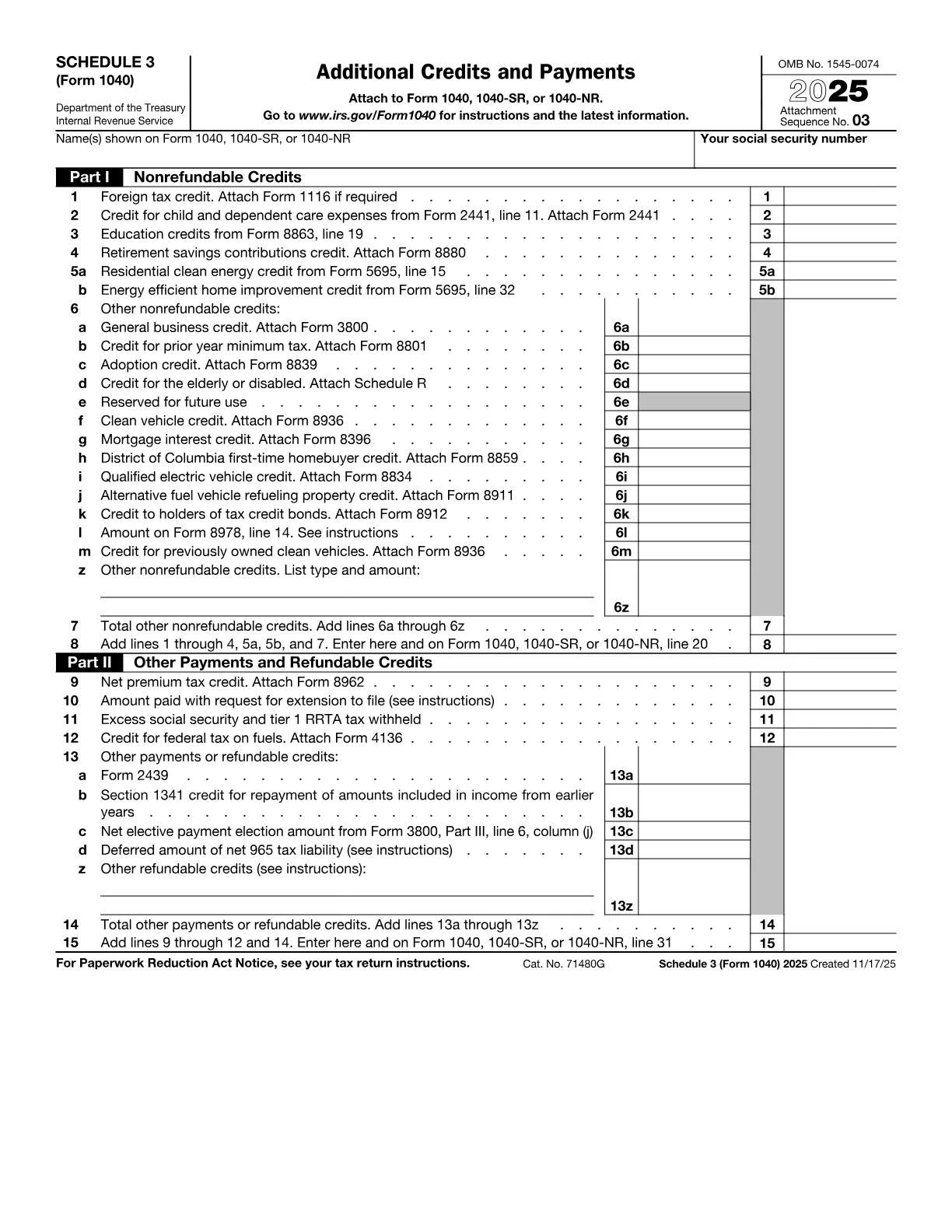
Every line, explained
No line matches that. Try a line number like 6c, or a word like premium.
Part I: Nonrefundable credits
1Foreign tax credit
Credit for income tax paid to a foreign country or US territory, often withheld on foreign dividends in a mutual fund. Form 1116 is usually required, but it can be skipped when all foreign income was interest and dividends reported on a 1099-INT, 1099-DIV or Schedule K-3, the foreign tax was not more than $300 ($600 married filing jointly), and the other conditions in the instructions are met.
Where it comes from: Form 1099-DIV box 7, Form 1099-INT box 6, Schedule K-3, or Form 1116.
Practice returns that fill in this line (1):
2Credit for child and dependent care expenses
Credit for paying someone to care for a qualifying child under 13, a disabled spouse or another disabled person who could not care for themselves, so the taxpayer could work or look for work.
Where it comes from: Form 2441, line 11, with the care provider's details and any dependent care benefits in Form W-2 box 10.
Practice returns that fill in this line (2):
3Education credits
The nonrefundable American opportunity credit and the lifetime learning credit. No education credit is allowed if the taxpayer is claimed as someone else's dependent, files married filing separately, or has Form 1040, line 11b, of $90,000 or more ($180,000 or more married filing jointly). The refundable part of the American opportunity credit goes on Form 1040, line 29.
Where it comes from: Form 8863, line 19, built from Form 1098-T and receipts.
Practice returns that fill in this line (2):
4Retirement savings contributions credit (saver's credit)
A credit for contributions to an IRA, a 401(k), 403(b), governmental 457(b), SIMPLE IRA or SEP, and certain ABLE account contributions. For 2025 it is not allowed if Form 1040, line 11b, is more than $39,500 ($59,250 head of household, $79,000 married filing jointly), or if the person contributing was born after January 1, 2008, is claimed as a dependent, or was a student.
Where it comes from: Form 8880, with Form W-2 box 12 and IRA contribution records.
Practice returns that fill in this line (1):
5aResidential clean energy credit
Credit for clean energy property, such as solar panels, installed on a home the taxpayer used as a residence in 2025. Condo and co-op owners count their share of the association's costs.
Where it comes from: Form 5695, line 15, with installer invoices.
Practice returns that fill in this line (1):
5bEnergy efficient home improvement credit
Credit for qualified energy efficiency improvements, such as insulation, windows, doors or a heat pump, made to the taxpayer's main home in the United States in 2025.
Where it comes from: Form 5695, line 32, with receipts.
Practice returns that fill in this line (1):
6aGeneral business credit
Business credits combined on Form 3800, which usually apply to partners, S corporation shareholders, the self-employed and rental owners. A net elective payment amount from Form 3800 goes on line 13c instead.
Where it comes from: Form 3800 and the forms for each credit, often from Schedule K-1.
Practice returns: none use this line yet. Request one.
6bCredit for prior year minimum tax
Part of an alternative minimum tax paid in an earlier year can come back as a credit in a later year when regular tax is higher than the AMT.
Where it comes from: Form 8801 and the prior year's Form 6251.
Practice returns: none use this line yet. Request one.
6cAdoption creditNew for 2025
The nonrefundable part of the credit for qualified adoption expenses, or for a special needs adoption that became final in 2025. New for 2025, up to $5,000 of the credit for each child is refundable; that part goes on Form 1040, line 30, not here.
Where it comes from: Form 8839.
Practice returns that fill in this line (1):
6dCredit for the elderly or disabled
A credit for people 65 or older, or retired on permanent and total disability, with low income.
Where it comes from: Schedule R.
Practice returns: none use this line yet. Request one.
6eReserved for future use
Blank for 2025.
Where it comes from: Nothing goes here.
Practice returns: none use this line yet. Request one.
6fClean vehicle credit
The personal-use part of the credit for a new clean vehicle. A buyer who transferred the credit to the dealer at the time of sale still files Form 8936 and Schedule A (Form 8936).
Where it comes from: Form 8936, Part III.
Practice returns: none use this line yet. Request one.
6gMortgage interest credit
Credit for a homeowner who received a mortgage credit certificate from a state or local government.
Where it comes from: Form 8396.
Practice returns: none use this line yet. Request one.
6h, 6iDC first-time homebuyer credit and qualified electric vehicle credit
Two expired credits that now appear only as carryforwards: the District of Columbia first-time homebuyer credit (no credit for a home bought after 2011) and the qualified electric vehicle credit (a passive activity credit carried from a vehicle placed in service before 2007).
Where it comes from: Form 8859 or Form 8834, and the prior year's return.
Practice returns: none use this line yet. Request one.
6jAlternative fuel vehicle refueling property credit
Credit for installing alternative fuel vehicle refueling property, such as an electric vehicle charger.
Where it comes from: Form 8911.
Practice returns: none use this line yet. Request one.
6kCredit to holders of tax credit bonds
Credit for holding certain tax credit bonds.
Where it comes from: Form 8912.
Practice returns: none use this line yet. Request one.
6lAmount on Form 8978, line 14
A partner's share of adjustments from a partnership audit. If Form 8978, line 14, is negative, a worksheet in the instructions limits what goes here and can send the rest to Schedule 2, line 17z.
Where it comes from: Form 8978.
Practice returns: none use this line yet. Request one.
6mCredit for previously owned clean vehicles
Credit for buying a used clean vehicle.
Where it comes from: Form 8936, Part IV.
Practice returns: none use this line yet. Request one.
6zOther nonrefundable credits
The 2025 instructions say to leave line 6z blank.
Where it comes from: Nothing goes here.
Practice returns: none use this line yet. Request one.
7Total other nonrefundable credits
Lines 6a through 6z added together.
Where it comes from: Lines 6a to 6z.
Practice returns that fill in this line (1):
8Add lines 1 through 4, 5a, 5b and 7
Total nonrefundable credits from this schedule, carried to Form 1040, line 20. The child tax credit and credit for other dependents are not here; they have their own line, Form 1040, line 19.
Where it comes from: The lines above.
Practice returns that fill in this line (8):
- Adoption credit and employer adoption benefits (Form 8839)
- Dependent care FSA and the child care credit
- Foreign dividends and the foreign tax credit
- Georgia family: Path2College 529 subtraction, dependent exemptions, and the 50% child care credit
- Graduate student with the Lifetime Learning Credit
- Saver's Credit with a 401(k) and a traditional IRA
- Solar, a battery, and a heat pump: both home energy credits on Form 5695
- Working student with an education credit
Part II: Other payments and refundable credits
9Net premium tax credit
If the premium tax credit the taxpayer qualifies for is more than the advance payments made to the Marketplace insurer, the difference is refunded here. If the advance payments were too high, the repayment goes on Schedule 2, line 1a instead.
Where it comes from: Form 8962, line 26, built from Form 1095-A.
Practice returns that fill in this line (1):
10Amount paid with request for extension to file
Any payment made with Form 4868 or Form 2350, or made to get an automatic extension. A convenience fee charged for paying by card is not included.
Where it comes from: The taxpayer's payment confirmation or IRS account.
Practice returns: none use this line yet. Request one.
11Excess social security and tier 1 RRTA tax withheld
When two or more employers together withheld Social Security or tier 1 RRTA tax on total wages of more than $176,100, the amount withheld over $10,918.20 is refunded here. Figure it separately for each spouse. If one employer alone withheld too much, it cannot be claimed here: the employer has to fix it, or the taxpayer files Form 843.
Where it comes from: Form W-2 box 4 from each employer.
Practice returns that fill in this line (1):
12Credit for federal tax on fuels
Credit for federal excise tax paid on fuel used for a nontaxable purpose, such as off-highway business use.
Where it comes from: Form 4136.
Practice returns: none use this line yet. Request one.
13aForm 2439
Tax a mutual fund or REIT paid on long-term capital gains it kept rather than distributed. The taxpayer gets credit for that tax here.
Where it comes from: Form 2439, box 2.
Practice returns: none use this line yet. Request one.
13bSection 1341 credit for repayment of amounts included in income from earlier years
Credit for paying back an amount that was included in income in an earlier year because it looked like the taxpayer had a right to it. Pub. 525 explains when the credit applies.
Where it comes from: Pub. 525 and the earlier year's return.
Practice returns: none use this line yet. Request one.
13cNet elective payment election amount from Form 3800
The amount of certain credits the taxpayer elected to receive as a payment (elective pay) instead of only using them against tax.
Where it comes from: Form 3800, Part III, line 6, column (j).
Practice returns: none use this line yet. Request one.
13dDeferred amount of net 965 tax liability
For a taxpayer who elected to pay the section 965 net tax liability in installments, the amount still to be paid in future years.
Where it comes from: Form 965-A.
Practice returns: none use this line yet. Request one.
13zOther refundable creditsNew for 2025
Credits with no line of their own, listed by type and amount: the section 960(c) excess limitation credit, and US tax allocable to the US Virgin Islands (Form 8689). New for 2025, a seller who elected to pay the tax on a sale of qualified farmland to a qualified farmer in installments enters 75% of the applicable net tax liability from Form 1062, line 14, identified as "1062NL".
Where it comes from: Form 1116, Form 8689 or Form 1062.
Practice returns: none use this line yet. Request one.
14Total other payments or refundable credits
Lines 13a through 13z added together.
Where it comes from: Lines 13a to 13z.
Practice returns: none use this line yet. Request one.
15Add lines 9 through 12 and 14
Total other payments and refundable credits, carried to Form 1040, line 31.
Where it comes from: The lines above.
Practice returns that fill in this line (2):
Practice it on a full return
Each Schedule 3 line starts on another form. The foreign dividends return claims line 1 without Form 1116, the child care credit return fills line 2 from Form 2441, the Marketplace insurance return reaches line 9 through Form 8962, and the job change return recovers excess Social Security tax on line 11. Browse every practice return, or go back to the interactive Form 1040 to see where lines 8 and 15 land.
FAQ
What is the difference between Part I and Part II of Schedule 3?
Part I lists nonrefundable credits, which can reduce your tax but not below zero; its total goes to Form 1040, line 20. Part II lists payments and refundable credits, which can produce a refund even when no tax is owed; its total goes to Form 1040, line 31.
Do I need Form 1116 to claim the foreign tax credit?
Not if all of your foreign income was interest and dividends reported on Form 1099-INT, 1099-DIV or Schedule K-3, your foreign taxes were not more than $300 ($600 married filing jointly), and you meet the other conditions in the instructions. Then you enter the credit directly on Schedule 3, line 1.
How do I get back excess Social Security tax withheld?
If two or more employers together withheld Social Security tax on more than $176,100 of 2025 wages, claim the amount withheld over $10,918.20 on Schedule 3, line 11, figured separately for each spouse. If a single employer withheld too much, the employer has to correct it; it can't be claimed on the return.
Does the child tax credit go on Schedule 3?
No. The child tax credit and the credit for other dependents are figured on Schedule 8812 and go on Form 1040, line 19. Schedule 3 is for the other nonrefundable credits.