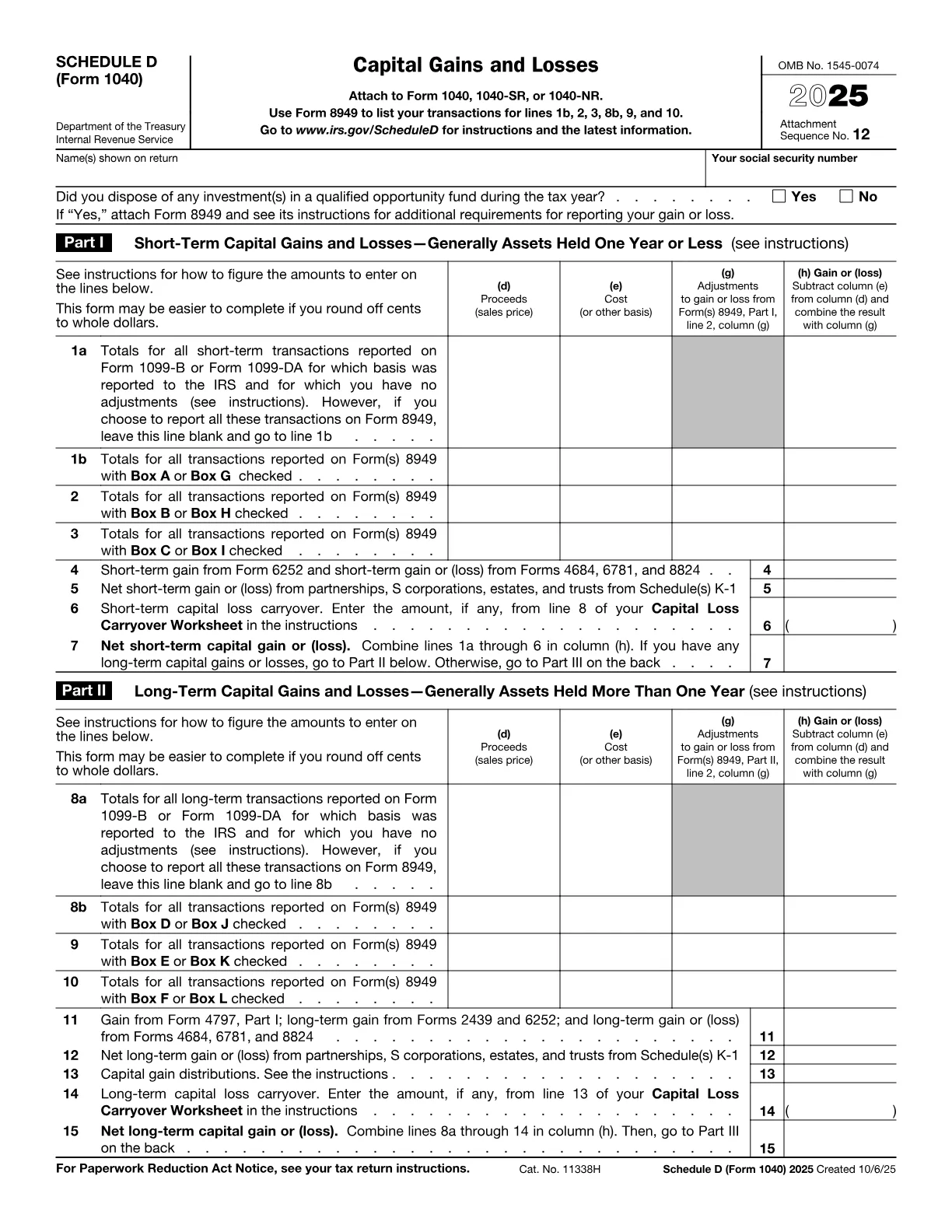
Schedule D brings together the year's capital gains and losses: sales of stocks, funds, crypto and other capital assets listed on Form 8949, capital gain distributions, gains and losses from other forms and K-1s, and loss carryovers. The net result goes on Form 1040, line 7a. Tap any line on the 2025 form below to see what goes there.
Every line, explained
No line matches that. Try a line number like 13, or a word like loss.
Qualified opportunity fund question
QOFDid you dispose of any investment(s) in a qualified opportunity fund during the tax year?
Every Schedule D answers yes or no. Yes means attaching Form 8949 with the extra details its instructions ask for, and completing Part III of Form 8997.
Where it comes from: The taxpayer's Form 8997 and brokerage records.
Part I: Short-term capital gains and losses (generally held one year or less)
1aTotals for short-term transactions on Form 1099-B or Form 1099-DA with basis reported to the IRS and no adjustmentsNew for 2025
A shortcut that skips Form 8949: the totals of short-term sales where the broker reported basis to the IRS and nothing needs adjusting (no wash sale, no basis correction, not a collectible). Enter total proceeds in column (d), total cost in (e) and the gain or loss in (h). For 2025, digital asset sales reported on the new Form 1099-DA qualify too.
Where it comes from: Form 1099-B or Form 1099-DA: short-term sales with basis reported to the IRS.
Practice returns that fill in this line (4):
1bTotals for all transactions reported on Form(s) 8949 with Box A or Box G checkedNew for 2025
Short-term sales listed on Form 8949 where the Form 1099-B (Box A) or Form 1099-DA (Box G, new for 2025) reported basis to the IRS, but something needs adjusting, such as a disallowed wash sale loss, or the taxpayer chose to list them. Column (g) carries the adjustments from Form 8949.
Where it comes from: Form 8949, Part I, with Box A or Box G checked.
Practice returns: none use this line yet. Request one.
2Totals for all transactions reported on Form(s) 8949 with Box B or Box H checkedNew for 2025
Short-term sales on a Form 1099-B (Box B) or Form 1099-DA (Box H, new for 2025) that did not report basis to the IRS. The taxpayer supplies the basis from their own records.
Where it comes from: Form 8949, Part I, with Box B or Box H checked, and the taxpayer's purchase records.
Practice returns that fill in this line (2):
3Totals for all transactions reported on Form(s) 8949 with Box C or Box I checkedNew for 2025
Short-term sales with no Form 1099-B (Box C) or Form 1099-DA (Box I, new for 2025) at all, such as a private sale.
Where it comes from: Form 8949, Part I, with Box C or Box I checked.
Practice returns that fill in this line (2):
4Short-term gain from Form 6252 and short-term gain or (loss) from Forms 4684, 6781, and 8824
Short-term amounts figured on other forms: installment sales (6252), casualties and thefts (4684), section 1256 contracts and straddles (6781), and like-kind exchanges (8824).
Where it comes from: Forms 6252, 4684, 6781 and 8824.
Practice returns: none use this line yet. Request one.
5Net short-term gain or (loss) from partnerships, S corporations, estates, and trusts from Schedule(s) K-1
The taxpayer's share of short-term capital gain or loss passed through from a partnership, S corporation, estate or trust.
Where it comes from: Schedule K-1.
Practice returns: none use this line yet. Request one.
6Short-term capital loss carryover
Unused short-term capital loss from 2024, from line 8 of the Capital Loss Carryover Worksheet in the instructions, entered in parentheses. The worksheet starts from the 2024 Form 1040, line 15, and the 2024 Schedule D.
Where it comes from: 2024 Form 1040 and Schedule D, through the Capital Loss Carryover Worksheet.
Practice returns that fill in this line (1):
7Net short-term capital gain or (loss)
Lines 1a through 6 combined in column (h).
Where it comes from: The lines above.
Practice returns that fill in this line (8):
- A personal loan to a friend goes bad
- Capital loss carryover from last year
- Crypto sales on the first Form 1099-DA, plus staking rewards
- Investor with dividends and stock sales
- Massachusetts renter with a brokerage account: the rental deduction and the three income classes
- Pennsylvania: PA wages, unreimbursed job expenses, and the Pittsburgh earned income tax
- RSU and ESPP sales: fixing the basis on Form 8949
- Selling personal items online with a Form 1099-K
Part II: Long-term capital gains and losses (generally held more than one year)
8aTotals for long-term transactions on Form 1099-B or Form 1099-DA with basis reported to the IRS and no adjustmentsNew for 2025
The same shortcut as line 1a, for long-term sales: basis reported to the IRS, no adjustments, no collectibles, so Form 8949 can be skipped. For 2025 it includes digital asset sales on Form 1099-DA.
Where it comes from: Form 1099-B or Form 1099-DA: long-term sales with basis reported to the IRS.
Practice returns that fill in this line (7):
- Capital loss carryover from last year
- District of Columbia investor: DC's own standard deduction and the out-of-state muni bond addback
- Investor with dividends and stock sales
- Massachusetts renter with a brokerage account: the rental deduction and the three income classes
- Missouri's new capital gain subtraction
- North Dakota: the 40% exclusion for capital gains and qualified dividends
- Wages, a rental, and a brokerage account
8bTotals for all transactions reported on Form(s) 8949 with Box D or Box J checkedNew for 2025
Long-term sales listed on Form 8949 where the Form 1099-B (Box D) or Form 1099-DA (Box J, new for 2025) reported basis to the IRS but an adjustment is needed, or the taxpayer chose to list them.
Where it comes from: Form 8949, Part II, with Box D or Box J checked.
Practice returns that fill in this line (1):
9Totals for all transactions reported on Form(s) 8949 with Box E or Box K checkedNew for 2025
Long-term sales on a Form 1099-B (Box E) or Form 1099-DA (Box K, new for 2025) that did not report basis to the IRS.
Where it comes from: Form 8949, Part II, with Box E or Box K checked, and the taxpayer's purchase records.
Practice returns that fill in this line (1):
10Totals for all transactions reported on Form(s) 8949 with Box F or Box L checkedNew for 2025
Long-term sales with no Form 1099-B (Box F) or Form 1099-DA (Box L, new for 2025). A home sale lands here when a Form 1099-S was issued or not all of the gain can be excluded; the exclusion goes in column (g) of Form 8949.
Where it comes from: Form 8949, Part II, with Box F or Box L checked, and Form 1099-S for a real estate sale.
Practice returns that fill in this line (3):
11Gain from Form 4797, Part I; long-term gain from Forms 2439 and 6252; and long-term gain or (loss) from Forms 4684, 6781, and 8824
Long-term amounts from other forms: the net gain from selling business property on Form 4797, Part I, undistributed capital gains from a fund (Form 2439), installment sales, casualties and thefts, section 1256 contracts and like-kind exchanges.
Where it comes from: Forms 4797, 2439, 6252, 4684, 6781 and 8824.
Practice returns that fill in this line (3):
12Net long-term gain or (loss) from partnerships, S corporations, estates, and trusts from Schedule(s) K-1
The taxpayer's share of long-term capital gain or loss passed through from a partnership, S corporation, estate or trust.
Where it comes from: Schedule K-1.
Practice returns: none use this line yet. Request one.
13Capital gain distributions
Long-term capital gain distributions from mutual funds and REITs, from Form 1099-DIV box 2a, however long the fund shares were held. A taxpayer whose only capital gains are these distributions may be able to put them straight on Form 1040, line 7a, without Schedule D.
Where it comes from: Form 1099-DIV box 2a.
Practice returns that fill in this line (2):
14Long-term capital loss carryover
Unused long-term capital loss from 2024, from line 13 of the Capital Loss Carryover Worksheet in the instructions, entered in parentheses.
Where it comes from: 2024 Form 1040 and Schedule D, through the Capital Loss Carryover Worksheet.
Practice returns that fill in this line (1):
15Net long-term capital gain or (loss)
Lines 8a through 14 combined in column (h).
Where it comes from: The lines above.
Practice returns that fill in this line (13):
- Capital loss carryover from last year
- Crypto sales on the first Form 1099-DA, plus staking rewards
- District of Columbia investor: DC's own standard deduction and the out-of-state muni bond addback
- Investor with dividends and stock sales
- Massachusetts renter with a brokerage account: the rental deduction and the three income classes
- Missouri's new capital gain subtraction
- North Dakota: the 40% exclusion for capital gains and qualified dividends
- RSU and ESPP sales: fixing the basis on Form 8949
- Seller-financed land sale on Form 6252
- Six K-1s, a partnership exit, and Section 1231
- Sold an inherited house
- Sold the rental house: Section 1231, unrecaptured 1250 gain, and freed passive losses
- Wages, a rental, and a brokerage account
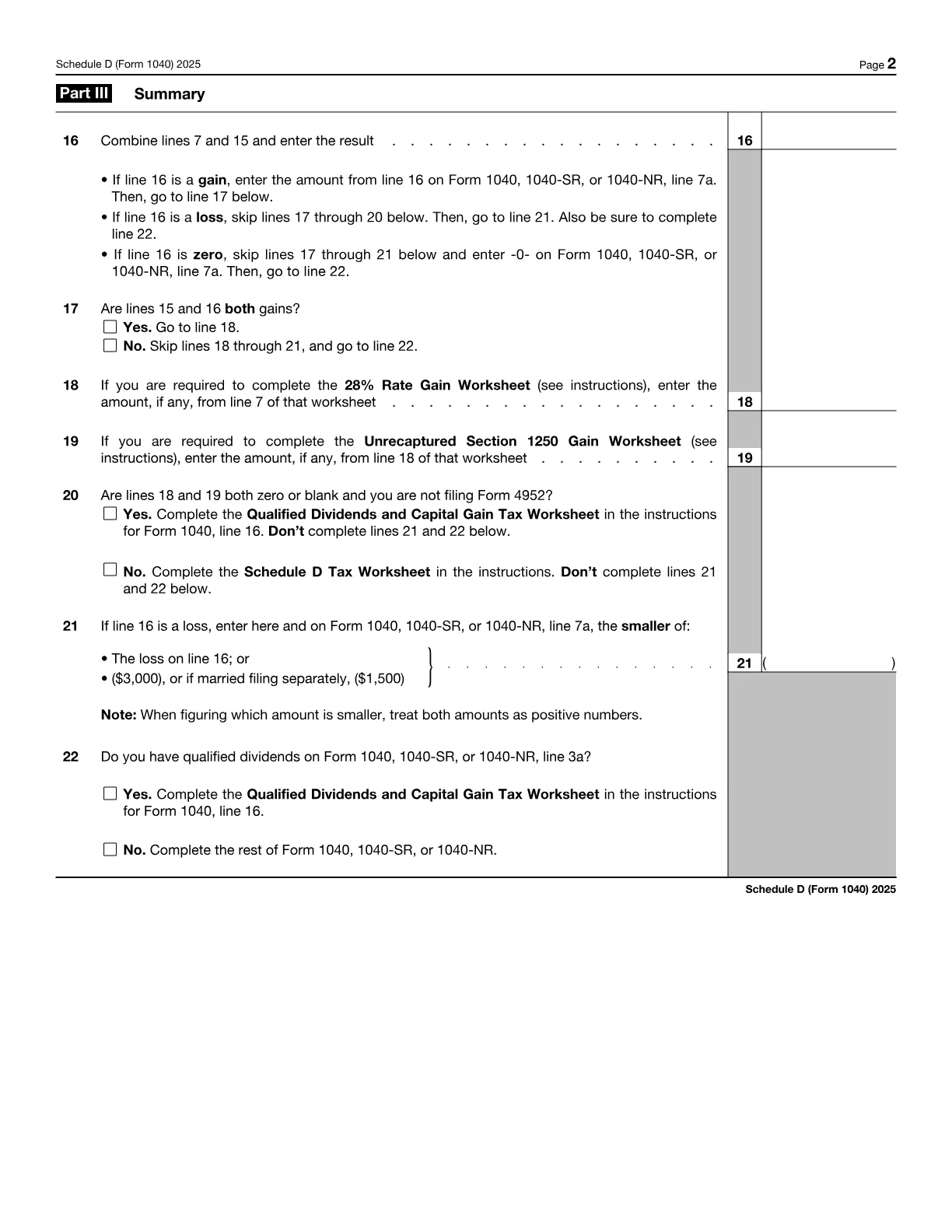
Part III: Summary
16Combine lines 7 and 15
The net capital gain or loss for the year. A gain goes on Form 1040, line 7a, then on to line 17. A loss skips to line 21. Zero means -0- on Form 1040, line 7a, then line 22.
Where it comes from: Lines 7 and 15.
Practice returns that fill in this line (16):
- A personal loan to a friend goes bad
- Capital loss carryover from last year
- Crypto sales on the first Form 1099-DA, plus staking rewards
- District of Columbia investor: DC's own standard deduction and the out-of-state muni bond addback
- Investor with dividends and stock sales
- Massachusetts renter with a brokerage account: the rental deduction and the three income classes
- Missouri's new capital gain subtraction
- North Dakota: the 40% exclusion for capital gains and qualified dividends
- Pennsylvania: PA wages, unreimbursed job expenses, and the Pittsburgh earned income tax
- RSU and ESPP sales: fixing the basis on Form 8949
- Seller-financed land sale on Form 6252
- Selling personal items online with a Form 1099-K
- Six K-1s, a partnership exit, and Section 1231
- Sold an inherited house
- Sold the rental house: Section 1231, unrecaptured 1250 gain, and freed passive losses
- Wages, a rental, and a brokerage account
17Are lines 15 and 16 both gains?
Yes means there is a net long-term gain, so the special rates on lines 18 and 19 may apply. No skips to line 22.
Where it comes from: Lines 15 and 16.
Practice returns that fill in this line (9):
- Crypto sales on the first Form 1099-DA, plus staking rewards
- District of Columbia investor: DC's own standard deduction and the out-of-state muni bond addback
- Massachusetts renter with a brokerage account: the rental deduction and the three income classes
- Missouri's new capital gain subtraction
- North Dakota: the 40% exclusion for capital gains and qualified dividends
- RSU and ESPP sales: fixing the basis on Form 8949
- Seller-financed land sale on Form 6252
- Selling personal items online with a Form 1099-K
- Sold the rental house: Section 1231, unrecaptured 1250 gain, and freed passive losses
1828% rate gain (from the 28% Rate Gain Worksheet)
Only when there is collectibles gain (art, antiques, coins, gold and silver bullion, gems, stamps and the like) or a partial section 1202 exclusion on small business stock. The worksheet in the instructions figures the gain that is taxed at no more than 28%.
Where it comes from: The 28% Rate Gain Worksheet, with Form 8949, Form 1099-DIV box 2d and K-1s.
Practice returns: none use this line yet. Request one.
19Unrecaptured section 1250 gain (from its worksheet)
The part of the gain on depreciated real property held more than a year, usually a rental, that comes from depreciation, figured on the Unrecaptured Section 1250 Gain Worksheet. It is taxed at no more than 25%. Form 1099-DIV box 2b and some K-1s report it too.
Where it comes from: The Unrecaptured Section 1250 Gain Worksheet, with Form 4797, Form 1099-DIV box 2b and K-1s.
Practice returns that fill in this line (1):
20Are lines 18 and 19 both zero or blank and you are not filing Form 4952?
Yes: the tax is figured with the Qualified Dividends and Capital Gain Tax Worksheet in the Form 1040 instructions. No: use the Schedule D Tax Worksheet in the Schedule D instructions. Either way, skip lines 21 and 22.
Where it comes from: Lines 18 and 19, and Form 4952 if there is investment interest.
Practice returns that fill in this line (8):
- Crypto sales on the first Form 1099-DA, plus staking rewards
- District of Columbia investor: DC's own standard deduction and the out-of-state muni bond addback
- Massachusetts renter with a brokerage account: the rental deduction and the three income classes
- Missouri's new capital gain subtraction
- North Dakota: the 40% exclusion for capital gains and qualified dividends
- RSU and ESPP sales: fixing the basis on Form 8949
- Seller-financed land sale on Form 6252
- Sold the rental house: Section 1231, unrecaptured 1250 gain, and freed passive losses
21If line 16 is a loss, the smaller of the loss or ($3,000), or ($1,500) if married filing separately
The capital loss deducted against other income this year, also entered on Form 1040, line 7a. Any loss beyond the limit carries over to 2026, figured with next year's Capital Loss Carryover Worksheet.
Where it comes from: Line 16 and the filing status.
Practice returns that fill in this line (4):
22Do you have qualified dividends on Form 1040, 1040-SR, or 1040-NR, line 3a?
Reached when line 16 is a loss or zero. Yes: use the Qualified Dividends and Capital Gain Tax Worksheet so the dividends still get the lower rates. No: finish Form 1040 as usual.
Where it comes from: Form 1040, line 3a.
Practice returns that fill in this line (5):
Practice it on a full return
Every practice return with investment sales gives you the taxpayer's Forms 1099-B, 1099-DIV and other documents, and an answer key with the completed Form 8949 and Schedule D, so you can see where each sale lands and check your own numbers. To see where line 16 or 21 ends up, follow it onto the interactive Form 1040.
FAQ
Do I need Form 8949, or can sales go straight on Schedule D?
Sales reported on Form 1099-B or Form 1099-DA where basis was reported to the IRS and nothing needs adjusting can go straight on line 1a (short-term) or line 8a (long-term) as totals, with no Form 8949. Anything else, such as a sale with no basis reported, a wash sale or a collectible, is listed on Form 8949 first.
How much of a capital loss can I deduct?
Up to $3,000 a year against other income, or $1,500 if married filing separately, on line 21. Any loss beyond that carries over to the next year as a short-term or long-term carryover, figured with the Capital Loss Carryover Worksheet.
Where do crypto sales go on Schedule D?
For 2025, brokers report digital asset sales on the new Form 1099-DA. They go on line 1a or 8a when basis was reported and no adjustment is needed, and otherwise on Form 8949 with the new boxes G, H or I (short-term) or J, K or L (long-term), which carry to lines 1b to 3 and 8b to 10.
What tax rate applies to long-term capital gains in 2025?
Long-term gains and qualified dividends are taxed at 0% to the extent they fall within taxable income up to $48,350 single, $96,700 married filing jointly or $64,750 head of household; at 15% up to $533,400 single or $600,050 married filing jointly; and at 20% above that. Collectibles gain (line 18) and unrecaptured section 1250 gain (line 19) are taxed at up to 28% and 25%.